
You're standing in a dealer lot in November rain, looking at two machines that'll do the same fence runs and feed hauls, except one's open to the weather and the other's got doors that thump shut like a truck. Do you pay for the enclosed cab, add doors later, or keep it open and dress for it? That decision isn't really about staying dry. It's about occupant containment, how fast you can get out, and what the added weight does to an electric UTV's working day.
Table of Contents
- Door Types Compared at a Glance
- How Doors Keep Occupants Inside the Protective Zone
- Weather Protection Versus Weight, Range and Payload
- Matching Door Setups to Hunting, Farm and Work Use
- Fitment Checks Before You Buy Doors
- OEM or Aftermarket Doors and Installation Options
- Maintaining Doors, Latches and Seals
- Confirm Your Door Setup Before You Buy
Door Types Compared at a Glance
No door wins on every count, and that's the point of comparing them side by side before you fall for a clean cab line. A UTV with doors can be safer, drier, and easier to live with, but only when the door stays latched, clears the belt, and suits how often you climb in and out. The four common setups below cover most of what you'll meet, factory fitted or added later.
| Door type | Rollover containment | Weather and dust | Visibility | Exit speed |
|---|---|---|---|---|
| Full hard doors | High when latched and used with belts | High | Limited by window size and tint | Slower, check latch and clearance |
| Half doors | Moderate, lower body only | Moderate | Good above the waist | Fast |
| Soft zip doors | Moderate, set by zip and strap tension | Good against rain and wind | Good through clear vinyl, can fog | Fast, zips can snag |
| Aftermarket enclosure | High when mounted to frame or cage | Very high | Set by pane area and pillar width | Check the exit path before buying |
Full Hard Doors
These are rigid panels, usually framed, with a positive latch and a window that opens, slides, or stays fixed. They're the strongest barrier against brush, mud, and cold air, and they give you the most containment when they're shut and you're belted. They're also the heaviest option and the slowest to clear if the machine's tipped against a bank or a latch is packed with grit. Work the handle from inside with gloves on before you judge them.
Half Doors
Half doors cover your legs and hips and leave everything above the waist open. Visibility's excellent, entry's quick, and the weight penalty is modest, which suits stop-start property work. The trade-off is plain: an arm can still leave the cab in an upset, and rain and dust come over the top. They block kicked-up stones and puddle splash well, but they won't turn the cab into a dry space.
Soft Zip Doors
Fabric, clear vinyl, zips, and straps make these the lightest and usually cheapest route to weather protection. They cut wind and driving rain surprisingly well for their weight and you can roll or remove panels in summer. Vinyl fogs on cold mornings, zips snag when they're muddy, and loose fabric flaps at speed and catches on brush. Tension matters. A sagging soft door that's half unzipped gives you little containment at all.
Aftermarket enclosures bolt or clamp to the frame or roll cage and often add a roof and windshield to the doors, giving the highest weather protection of the group. Quality spreads widely, so the exit path needs your closest attention.
Pick the door that stays latched and keeps your belts usable during normal work, not the one with the most glass or the most panels.
How Doors Keep Occupants Inside the Protective Zone
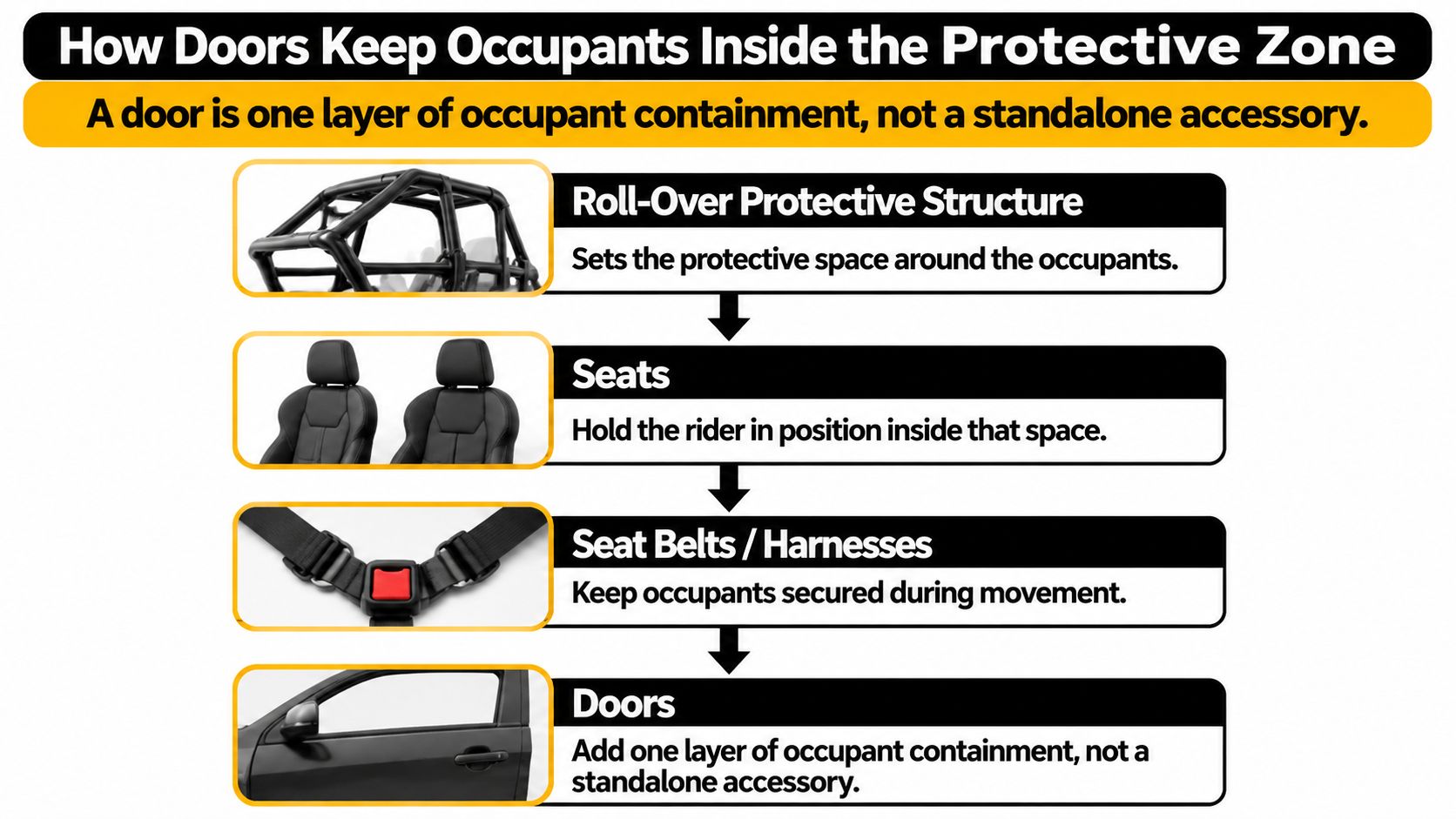
A door is one layer of occupant containment, not a safety system on its own. Think of the cab as a protective zone that only works when its parts work together, in a specific order. Break any link in that chain and the door becomes weather equipment with a handle.
How the System Fits Together
First, the roll-over protective structure, the cage over the seats, holds open a survival space if the machine goes over. Second, the seats and seat belts or harnesses keep you inside that space instead of being thrown partway out of it. Third, doors or nets close the side opening so arms and legs stay inside the space during a rollover or a hard side impact. That's the primary safety value of a UTV with doors, ahead of comfort.
WorkSafe Tasmania's safety alert on side-by-side vehicles reports a serious rollover where cab nets or doors were absent and the operator sustained arm and leg injuries, and it recommends keeping doors or nets installed, wearing seat belts, and training operators. WorkSafe Western Australia describes the same division of labor, with the protective structure preserving the space, belts keeping occupants in it, and doors or nets stopping limbs from leaving it.
Habits That Make the Hardware Work
Hardware can't fix how the machine's driven. Ohio State University's agricultural safety guidance for utility vehicles advises keeping arms and legs inside, driving slowly, turning smoothly, and traveling directly up or down slopes rather than turning across them. On mud, loose soil, and wet grass, those habits matter as much as the door, because a sideways slide on a slope is how a lot of working rollovers start.
Check any door against three points. It latches positively when closed, with a click you can feel. It can't be lifted off or unclipped on the trail in a way that encourages running without it. It doesn't pinch, reroute, or block the belt or buckle. I'd also pull hard on a closed door from inside. Hinge play and a latch that only half engages show up immediately.
Site crews checking the rest of their protective kit alongside vehicle gear can use resources like Refinery Work Wear Canada vehicle safety to round out what operators wear and carry. But hear this plainly: doors without belts don't protect you. An unbelted occupant moves inside the cab during an upset, door or no door, and the door can't hold a body in the seat.
Weather Protection Versus Weight, Range and Payload
The heaviest door isn't automatically the safest, and on an electric machine that assumption costs you twice. Every pound of door is a pound of payload you can't carry in feed, tools, or a passenger's gear, and it's mass the motor has to move on every start, hill, and trailer pull. That trims the working range you planned your day around, a trade-off worth weighing before you choose an enclosed side-by-side setup for year-round work.
Materials Side by Side
- Soft vinyl and fabric: Lowest weight and easy to clear in a hurry, but the least latch security and the shortest life in sun and brush.
- Aluminum: A rigid frame at moderate weight with good corrosion resistance, and it won't rust where the finish chips.
- Steel: The most structure and the most mass, and bare spots rust if you don't stay ahead of paint damage.
Visibility deserves equal weight, especially for hunters moving at first and last light. Tinted or thick windows cut what little light you have at dawn and dusk, and any pane can fog when warm breath meets cold glass or vinyl. Sit in the machine at the light level you'll work in and look over both shoulders.
Cold already taxes an electric UTV before you add door weight. The University of Alaska Fairbanks cold weather assessment for electric vehicles reports that below 0°C (32°F) lithium-ion discharge capacity falls substantially, with tested cells retaining about 77% of their energy at −10°C (14°F) compared with 25°C (77°F), and that outdoor-stored EVs can lose up to 69% of range, with severe cold cutting practical range to one-half or one-third of the official figure and towing reducing it further.
Payload test: If a door set adds more weight than the load you typically carry, reconsider the design.
Ask the dealer for a cold weather range figure, not only the laboratory number. Then answer one question: which design gives enough weather and debris protection without costing you restraint, visibility, exit speed, or range?
Matching Door Setups to Hunting, Farm and Work Use
Your work decides the door, because each job carries a different main risk. A hunter easing down a brush trail at dawn, a rancher crossing a wet hillside with mineral tubs, and a warehouse hand climbing out forty times a shift don't need the same cab. Start from the risk, then pick the door that handles it without giving up restraint.
| Use | Main priority | Recommended setup | Avoid |
|---|---|---|---|
| Hunting from a UTV | Quiet, low-light visibility and branch protection | Soft zip or half doors with clear windows and belts used | Heavy hard doors that block shooting angles |
| Farm and ranch work | Dust, rain and livestock clearance on slopes | Latched full doors or an aftermarket enclosure | Loose zips that flap in wind |
| Construction site | Impact and debris protection | Full hard doors with a belt-use policy | Removable panels without positive latches |
| Warehouse or property work | Frequent entry and exit | Half doors with positive latches | Doors that slow fast egress |
Hunting
Hunters lean toward soft or half doors for good reasons. They're quiet, they don't block shooting angles or binocular work, and clear panels keep thorn and branch whip off your legs. If you're comparing machines built for this use, hunting utility vehicles shows how door choice fits the wider setup. The discipline still matters, though: belts on and doors closed whenever the machine's moving, especially on side hills between stands.
Farm, Ranch, and Site Work
Slope work changes the ranking. When you're checking fence on a hillside or hauling across greasy pasture, containment outranks comfort, so latched full doors or a properly mounted enclosure earn their weight. They also keep dust, rain, and livestock pressure off you at gates. Construction users face debris and struck-by hazards, so full hard doors make sense, paired with a written belt-use policy that supervisors enforce. A door policy nobody follows is paperwork.
Warehouse and property work runs the other way. If you're out at every stop to open a gate, read a meter, or grab a tool, a slow door gets left open or removed, and then it protects nobody. Half doors with positive latches keep legs covered and exits fast.
Before you decide, ask which door you'd want fitted on the worst day of your year, not the nicest one.
Fitment Checks Before You Buy Doors
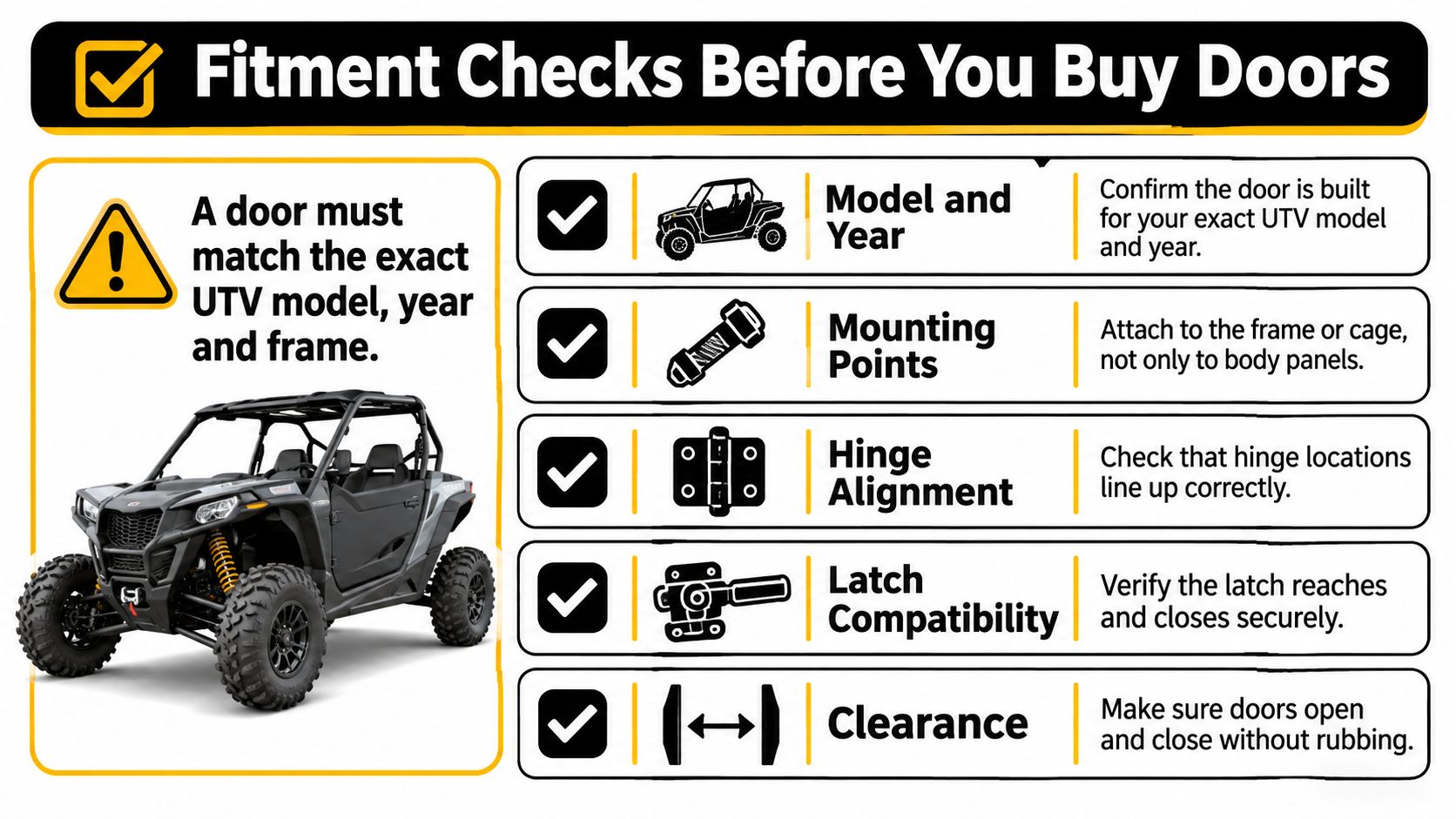
A door must match your exact UTV model, year, and frame. Close enough isn't a fitment standard, and universal kits are where most door regrets start. Run these checks in the dealer lot, in order, with the seller standing there.
| Check | What to verify | Red flag |
|---|---|---|
| Model and year | Kit lists your exact UTV model and year | Universal claim with no model list |
| Mounting points | Doors bolt to frame or roll cage, not only body panels | Clamps onto body panels only |
| Seat belt routing | Belt and buckle clear the door and latch | Door frame pinches or blocks the belt |
| Latch retention | Positive latch that stays closed under load | Friction latch or bungee retention |
| Opening and exit | Door opens wide enough for a fast exit | Door blocks hip or leg movement |
| Added weight | Published weight is known and fits your payload | Weight not published |
The Engineering Benchmark
OSHA's rollover protection standard for construction equipment emphasizes that protective structures must preserve a safe operator zone and that exits shouldn't be positioned so one accident can block both, and its rules link seat-belt use to equipment with rollover protection. Those provisions don't automatically certify a recreational or farm UTV, but they're a sound benchmark: doors should keep you inside the protective envelope, stay latched under dynamic load, and still allow rapid egress after an upset, with nothing protruding into the occupant zone.
The common mistake is buying a universal kit without confirming the mounts reach a structural member. If you're fitting doors to a compact machine like a UTV 2 seater, check mount locations twice, because electric models route batteries and wiring through spots that limit where you can drill. Ask the dealer before any hole goes in.
Then run the practical test. Sit in the seat, belt fastened, door closed, wearing your work gloves. Release the belt and open the door by hand, from inside, quickly, without tools. If your hip hangs up or the latch needs two hands, walk away.
One legal note: a door alone doesn't make a UTV street legal. Road use may also require mirrors, turn signals, a horn, and compliant restraints, so confirm your local equipment list before buying doors for road travel.
OEM or Aftermarket Doors and Installation Options
Where the door comes from matters almost as much as what it's made of, because sourcing decides fit, warranty handling, and who helps when a latch won't adjust. OEM kits are built for the exact model and usually sit under dealer or factory warranty terms. Aftermarket kits spread from excellent to flimsy, and seller support spreads just as far.
| Option | Fit | Warranty and support | Install path | Best for |
|---|---|---|---|---|
| OEM dealer kit | Built for your model | Usually under dealer or factory terms | Dealer installs or guides | Owners who want simple warranty handling |
| Aftermarket bolt-on kit | Model-specific kits, check mounts closely | Set by each seller in writing | DIY with basic tools or a shop | Budget-conscious owners |
| Universal soft doors | Adjustable, less precise | Limited | DIY with straps and zips | Light use and weather protection |
| Custom enclosure | Built to your frame | Set by the builder in writing | Shop fabrication | Heavy-duty work and cold weather |
Three Ways Doors Get Installed
Dealer installation costs more and buys you torque checks, correct mount placement, and someone accountable if a door rattles or a belt rubs. That's worth it on an electric machine where drilling near wiring carries real risk. A DIY bolt-on suits owners with a socket set, a torque wrench, and patience. Shop fabrication fits custom enclosures, where a builder measures your frame and welds or bends to match.
If you're doing it yourself, follow this sequence:
- Confirm fitment: Verify the kit lists your exact model and year.
- Dry-fit first: Hang every mount and panel before drilling anything.
- Torque to spec: Tighten mounts to the kit specification, not by feel.
- Route the belts: Run each belt through its path and check for pinch points.
- Cycle the doors: Open and close each door ten times and confirm latch engagement every time.
Installation time varies by kit, so ask the seller for the expected time before you plan a Saturday around it. Adding aftermarket doors can affect frame or body warranty coverage, so get the answer in writing before you order. I'd buy from a seller who lists model fitment in writing and answers mount questions directly. Vague fitment claims become your problem the day the box arrives.
Maintaining Doors, Latches and Seals
A loose hinge or a worn latch can let a door open during an upset, which makes door maintenance part of your restraint system, not cosmetic care. Treat these checks as a recurring habit tied to how rough your ground is.
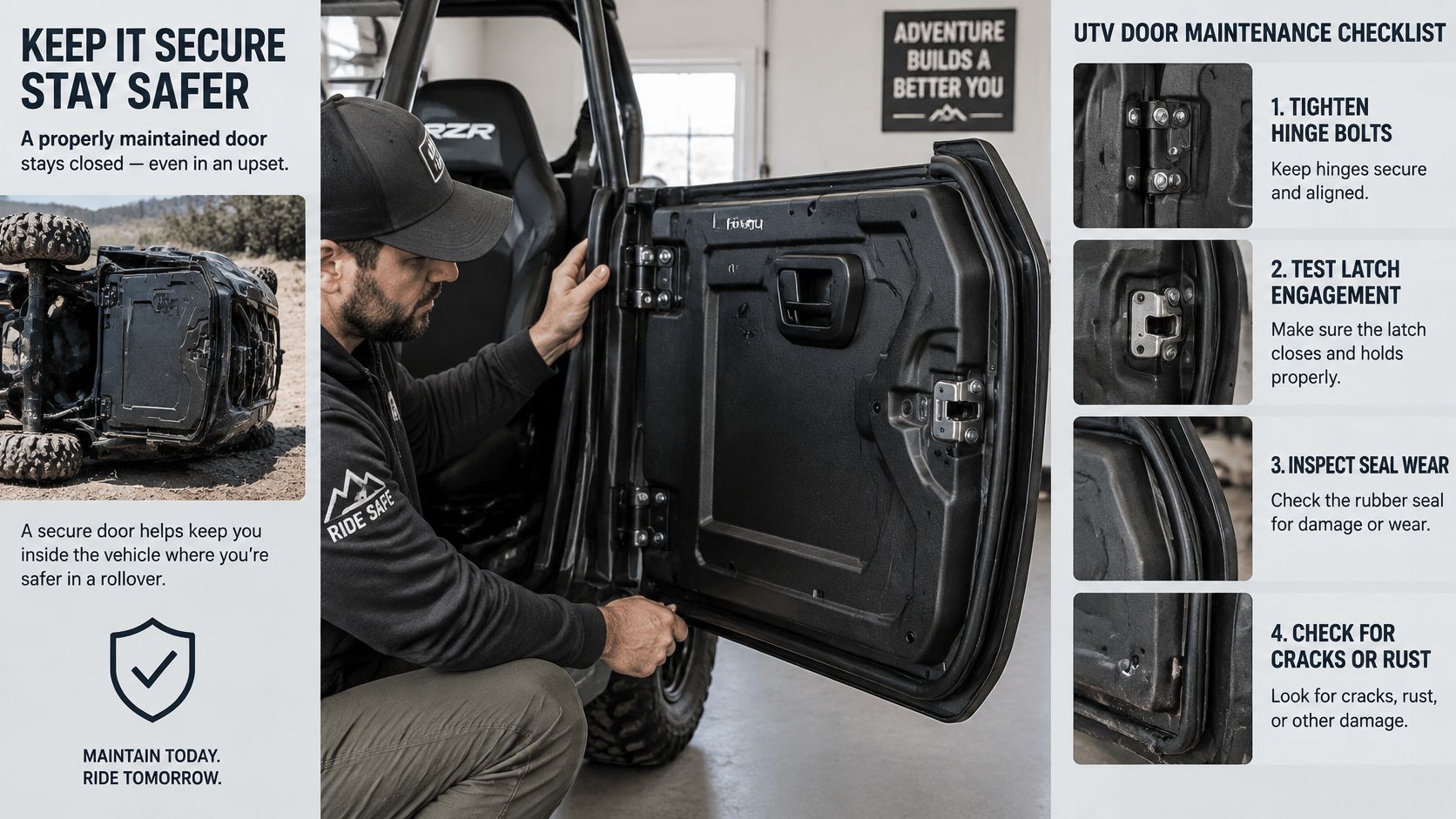
- Latch and striker: Inspect engagement and striker wear before each use, and confirm the positive click.
- Hinge and mount bolts: Check for loosening after rough trails, washboard, or trailer hauls.
- Lubrication: Use a light grease or dry lube suited to your climate on hinges and latch pivots.
- Soft door condition: Inspect zips, seams, and vinyl windows for tears and UV cracking.
- Washdown: Rinse mud and salt that trap moisture against steel or aluminum frames.
- Window panels: Replace fogged or cracked panels before they fail or block your view.
Cold adds one caution. Vinyl stiffens below freezing and can crack if you force it, so warm the vehicle up before zipping or unzipping soft doors on a frosty morning. Work the zip slowly and keep grit out of the teeth with a soft brush.
If a door needs force to latch, it isn't ready for work.
Fix alignment, striker position, or a bent hinge first. Slamming a door into submission only wears the parts that are supposed to hold it shut when it counts.
Confirm Your Door Setup Before You Buy
Before you call or visit, write down four things: your exact UTV model and year, your main use, the door type you've chosen, and the single priority that decided it. That short list keeps the conversation on fitment instead of drifting into whatever's on the showroom floor.
Then ask the dealer for three confirmations in writing: fitment for that exact model and year, latch and belt routing that clear the chosen door, and the installation path with its effect on frame or body warranty. Add a fourth question on the published added weight and how it changes your payload and expected cold weather range. Ask whether the doors can be installed and tested, belt on and gloves on, before the machine leaves the lot.
We sell the Campus E1 through authorized dealers, and you can find a dealer near you to book a test drive and check door options in person with your own belts and work gear. We also sell genuine parts and accessories on our website. Confirm current options and availability with the dealer before ordering, since products and accessories may change without notice.
Compare electric UTVs built for hunting, ranch, farm, and property work, then test door fit, latch feel, and belt clearance in person before you commit. Visit Campus EV to find an authorized dealer near you, book a test drive, and confirm the door setup that suits your work.