
An electric dirt bike can cost about $229 to $1,000 for a basic kids' model, $3,000 to $6,500 for an adult trail bike, and more than $10,000 for a premium full-size machine, with the highest listed example reaching $13,040. For adult riders who want genuine trail capability without paying premium-bike money, the practical value range is roughly $3,000 to $4,100.
A first-time buyer comparing electric and gas bikes can easily assume the cheapest listing is the best deal. Then the battery specifications, charger, suspension, replacement parts, warranty, and long-term ownership costs enter the conversation, and the decision becomes less obvious. The price spread exists because “electric dirt bike” covers everything from a small children's runabout to a road-legal performance motorcycle.
The useful way to evaluate electric dirt bike cost has three layers:
- Purchase price, which tells you what you'll pay at the dealer or seller.
- Component value, especially the battery, motor, controller, suspension, and frame.
- Total ownership cost, including electricity, battery replacement, maintenance, depreciation, and support.
That third layer changes the buying conversation. Charging usually costs very little, but a replacement battery can become a major expense for a frequent rider. A bike with a modest sticker price may not be economical if its pack is difficult to replace or its support network is weak.
Table of Contents
- Introduction to Electric Dirt Bike Cost Today
- Electric Dirt Bike Price Ranges by Class and Rider Type
- What Drives Electric Dirt Bike Cost Most
- Total Cost of Ownership and Charging Versus Battery Replacement
- Electric Versus Gas Dirt Bike Cost Comparison
- Financing Incentives and Smart Buying Tips for Every Rider
- Making the Right Choice for Your Budget and Riding Goals
Introduction to Electric Dirt Bike Cost Today
A current independent guide places electric dirt bike prices from about $229 for a basic Razor youth bike to $13,040 for a road-legal Stark Varg EX. That spread covers more than 50 times between the lowest and highest listed prices, but the comparison becomes clearer once battery economics and intended use enter the discussion.
A youth Razor and a Stark Varg are built for different jobs. Rider size, motor output, battery capacity, suspension, frame strength, legal equipment, and component quality all affect the sticker price. Adult trail bikes from Sur-Ron, Talaria, Segway, and Rawrr generally fall between $3,000 and $6,500, according to the electric dirt bike price guide.
Why the price spread feels so confusing
A children's bike may use low-speed controls, compact dimensions, and simpler equipment. An adult trail bike needs a stronger chassis, more capable suspension, a larger battery, higher motor output, and parts that can tolerate repeated off-road impacts. A premium full-size model adds stronger power delivery, more battery capacity, advanced chassis components, and sometimes road-legal equipment.
The motor is only one part of the cost. The battery stores the energy, the controller meters torque, the cooling system manages heat, and the frame and suspension absorb the trail's punishment. The battery also changes the long-term calculation. Charging is usually inexpensive, while replacing a worn or damaged pack can become one of the largest ownership expenses.
Practical rule: Compare bikes within the same rider class first. A low-priced kids' bike is not a bargain if you need adult ergonomics, trail durability, or a battery suited to regular riding.
The cost question that matters most
Start with the rider and the workload. A parent choosing a quiet beginner bike has different priorities from an adult trail rider. A rancher or hunter may care more about range, battery replacement, and local service access than peak speed.
The purchase price is the entry fee, not the whole bill. Electricity, maintenance, depreciation, support, and eventual battery replacement determine whether the bike remains affordable over time. A lower-priced model can cost more to keep riding if its battery is difficult to source or its manufacturer offers limited support.
Ask three questions before comparing listings: What class of bike fits the rider? Which components explain the price? What will ownership cost after the purchase? These questions keep a flashy specification or unusually low price from deciding the purchase alone.
Electric Dirt Bike Price Ranges by Class and Rider Type
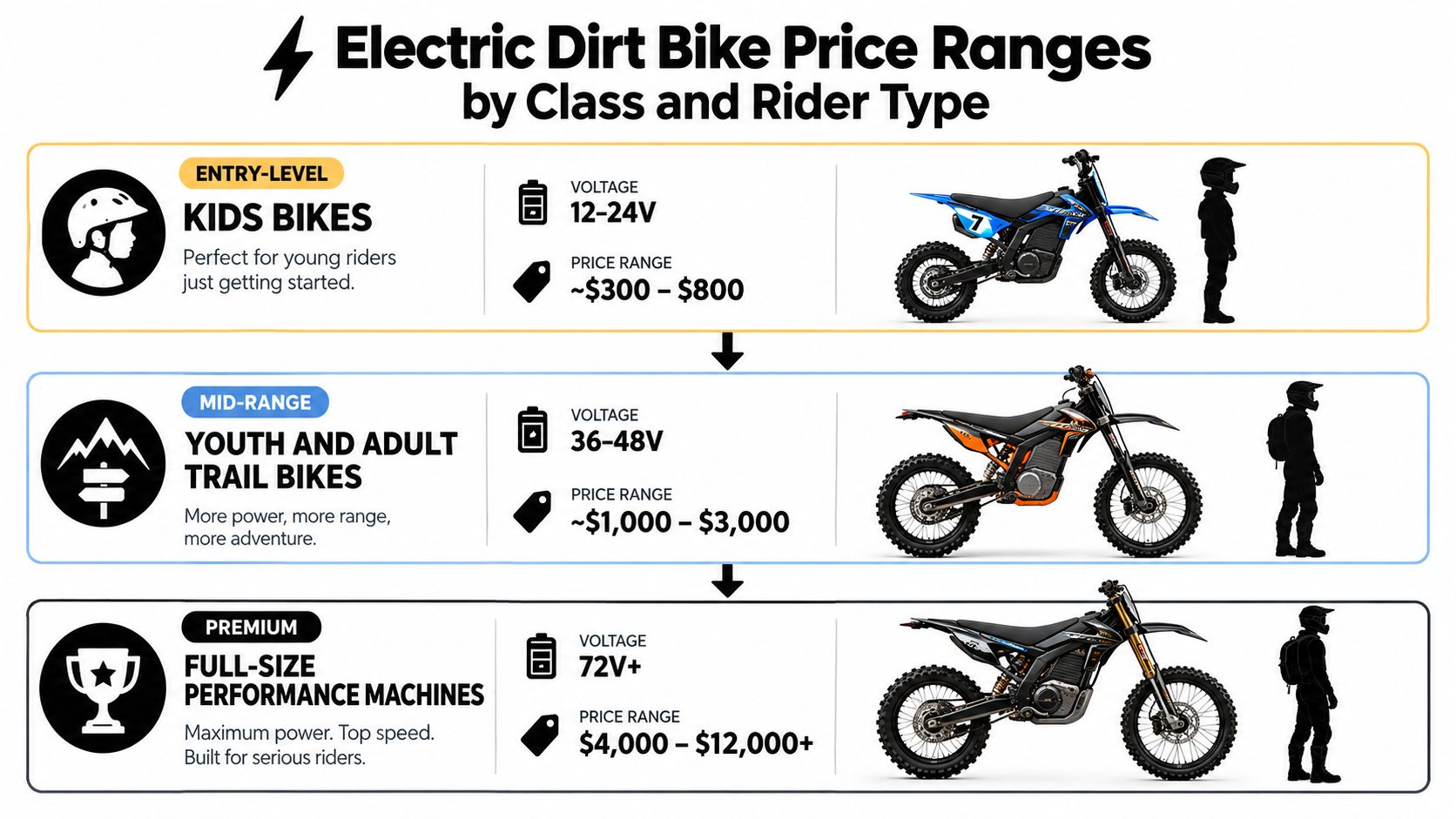
Electric dirt bike prices span from roughly $229 for basic children's models to more than $10,000 for premium full-size machines. The useful comparison is not the cheapest sticker price. Match the bike to the rider's size, terrain, and workload first, then examine how much battery capacity and replacement support come with that price.
Entry-level kids' bikes
Basic children's models generally cost around $229 to $1,000, according to the independent 2026 market guide. Their smaller dimensions, simpler controls, and limited performance suit early practice with balance and throttle control. Those same limits usually rule them out for adult trail riding.
Fit matters more than saving the last few dollars. A child who outgrows a bike quickly can turn a low purchase price into an early replacement. Check seat height, controls, wheel size, and the availability of replacement batteries and other wear parts.
Youth and beginner trail models
Stronger youth bikes and entry-level trail machines typically occupy the next tier. Historical pricing guides place entry-level bikes around $300 to $1,000 and mid-range machines around $1,000 to $3,000, as summarized by Dirt Bike HQ's electric dirt bike cost guide.
These bikes may add more usable suspension, a larger chassis, and a battery suited to longer recreational rides. The word “adult” in a listing still needs careful checking. Adult use depends on seat height, wheel strength, braking, suspension travel, and load capacity, not just a higher voltage rating. A battery that is inexpensive to charge can still become the largest future expense if replacement packs are hard to source.
Adult trail bikes
For serious off-road use, the practical benchmark is the $3,000 to $6,500 range. Sur-Ron, Talaria, Segway, and Rawrr models commonly appear here, offering adult ergonomics and performance for real trail riding.
Independent 2025 and 2026 buying coverage identifies a value sweet spot around $3,000 to $4,100. This range often suits recreational trail riders who need more capability than a beginner bike without paying for the highest output available. Before buying, confirm battery availability, charger support, and local service. Low charging cost helps only when the bike can remain in service.
Premium full-size performance bikes
Premium machines can exceed $10,000. Pricing coverage lists the Sur-Ron Light Bee X at about $4,400 to $5,500, the KTM Freeride E-XC around $10,500, and the Stark Varg at roughly $11,900 to $13,040, depending on trim and legality.
At this level, the price reflects a complete performance package. Frame construction, motor output, suspension, electronics, braking, battery design, and road equipment can all contribute. Compare those parts with expected riding hours and future battery cost, rather than treating the largest battery or highest output as automatically better value.
What Drives Electric Dirt Bike Cost Most
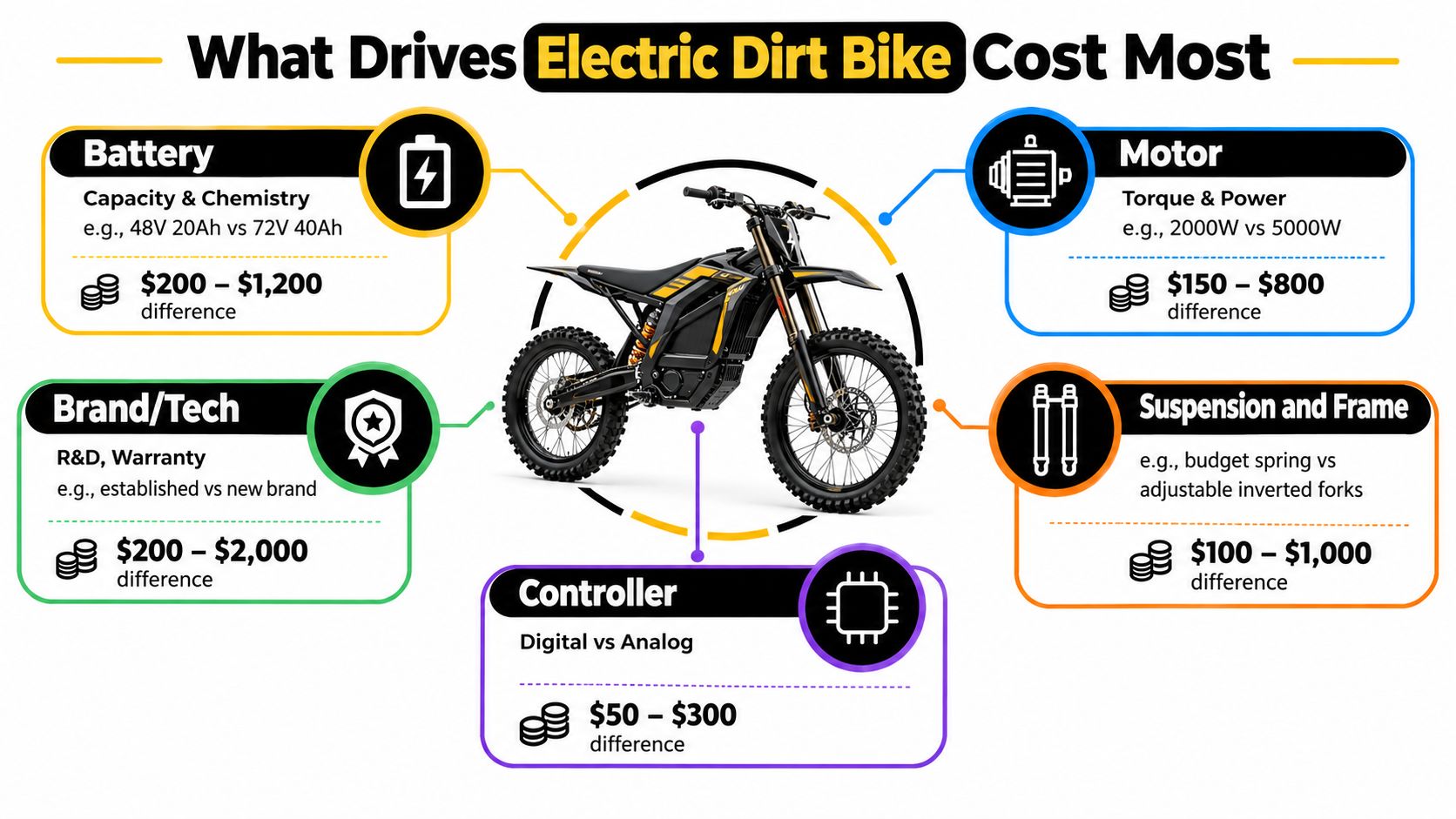
Two bikes can look similar in a photograph and still differ by thousands of dollars. The difference usually sits inside the frame, in the battery pack, controller, motor, suspension hardware, and manufacturing support.
Battery capacity and construction
The battery is the closest equivalent to a fuel tank and part of the engine system combined. More capacity can provide more range, but it also adds weight, structural demands, suspension tuning requirements, shipping expense, and protection hardware.
Independent market data places lithium-ion battery packs at about $112 per kilowatt-hour at pack level in 2025. At that benchmark, a 4 kWh off-road pack represents roughly $448 before integration costs such as the battery-management system, enclosure, wiring, thermal management, labor, and margin, as explained in this electric motorcycle battery cost guide.
That benchmark isn't the retail price of a finished replacement pack. It helps explain why a larger, better-protected battery can move a bike into a higher price class.
Motor and controller
Motor output affects acceleration, hill climbing, sustained load, and heat management. The controller determines how smoothly and consistently the battery's energy reaches the motor. A strong motor paired with an inadequate controller won't deliver a balanced riding experience, while advanced electronics can make power easier to manage on loose terrain.
Look beyond a single peak-power figure. Ask how the system behaves under sustained load, whether power modes are adjustable, and whether the controller and motor have dependable cooling and service support.
Suspension, frame, and brakes
Off-road impacts expose weak hardware quickly. A budget spring fork may work for gentle paths but offer little adjustment for rider weight or aggressive terrain. Better suspension, stronger wheels, more capable brakes, and a rigid frame raise manufacturing cost because they require more material, tuning, and testing.
A price sheet becomes a riding experience. A cheaper bike may still move quickly, but it may not track confidently through rocks, absorb repeated hits, or remain comfortable over a long trail.
Electronics, battery management, and displays
The battery-management system protects cells during charging and discharging. Displays, wiring, sensors, chargers, and safety cutoffs also affect reliability. These parts don't always attract attention during a showroom inspection, but they influence whether the bike starts consistently and whether a dealer can diagnose problems.
Brand support and integration
A portion of the price pays for design work, quality control, warranty administration, parts availability, and dealer support. Two bikes with similar battery capacity and motor ratings may have very different ownership experiences if one has a clear parts pipeline and the other relies on hard-to-identify components.
A spec sheet can tell you what a bike claims to have. It can't, by itself, tell you how well those parts work together or how easy they are to replace.
Total Cost of Ownership and Charging Versus Battery Replacement
Electricity is usually the least expensive part of operating an electric dirt bike. At an average U.S. residential rate near $0.18 per kWh, a full charge costs about $0.36 for a 2 kWh pack, $0.72 for a 4 kWh pack, and $1.26 for a 7 kWh pack, based on the motorcycle battery operating-cost analysis.
| Battery size | Full charge cost | Use case context |
|---|---|---|
| 2 kWh | About $0.36 | Smaller trail or lighter-duty riding |
| 4 kWh | About $0.72 | Full-size trail use |
| 7 kWh | About $1.26 | Higher-performance riding |
These figures describe a full charge, not necessarily the cost of every ride. If you return with energy remaining, the actual recharge is lower. Electricity rates also vary by location, and charging losses mean the wall outlet may supply somewhat more energy than the battery stores.
Why the battery changes the ownership equation
Replacement packs deserve more attention than charging. Independent coverage commonly places replacement batteries around $1,000 to $2,500 after about 500 to 1,000 or more charge cycles, with larger-capacity bikes sometimes costing more, according to this electric dirt bike ownership guide.
That difference matters most to heavy users. A rider who charges occasionally may treat the pack as a long-term concern, while a fleet, farm, or frequent trail rider should ask about cycle life, warranty coverage, depth of discharge, storage conditions, and replacement availability before buying.
The useful comparison isn't range alone. Compare cost per usable kilowatt-hour and the cycle-life-adjusted cost of the pack.
Depreciation also matters because the battery is a valuable part of the bike. A machine with a healthy, documented pack may be easier to sell than one with uncertain battery history, even if both have similar cosmetic condition.
For maintenance guidance, use this electric bike maintenance resource to build a routine around charging, storage, inspection, and wear items. Buyers comparing broader electric-vehicle ownership can also check GMC Hummer EV for a separate example of how battery condition and vehicle history affect purchase decisions.
Electric Versus Gas Dirt Bike Cost Comparison
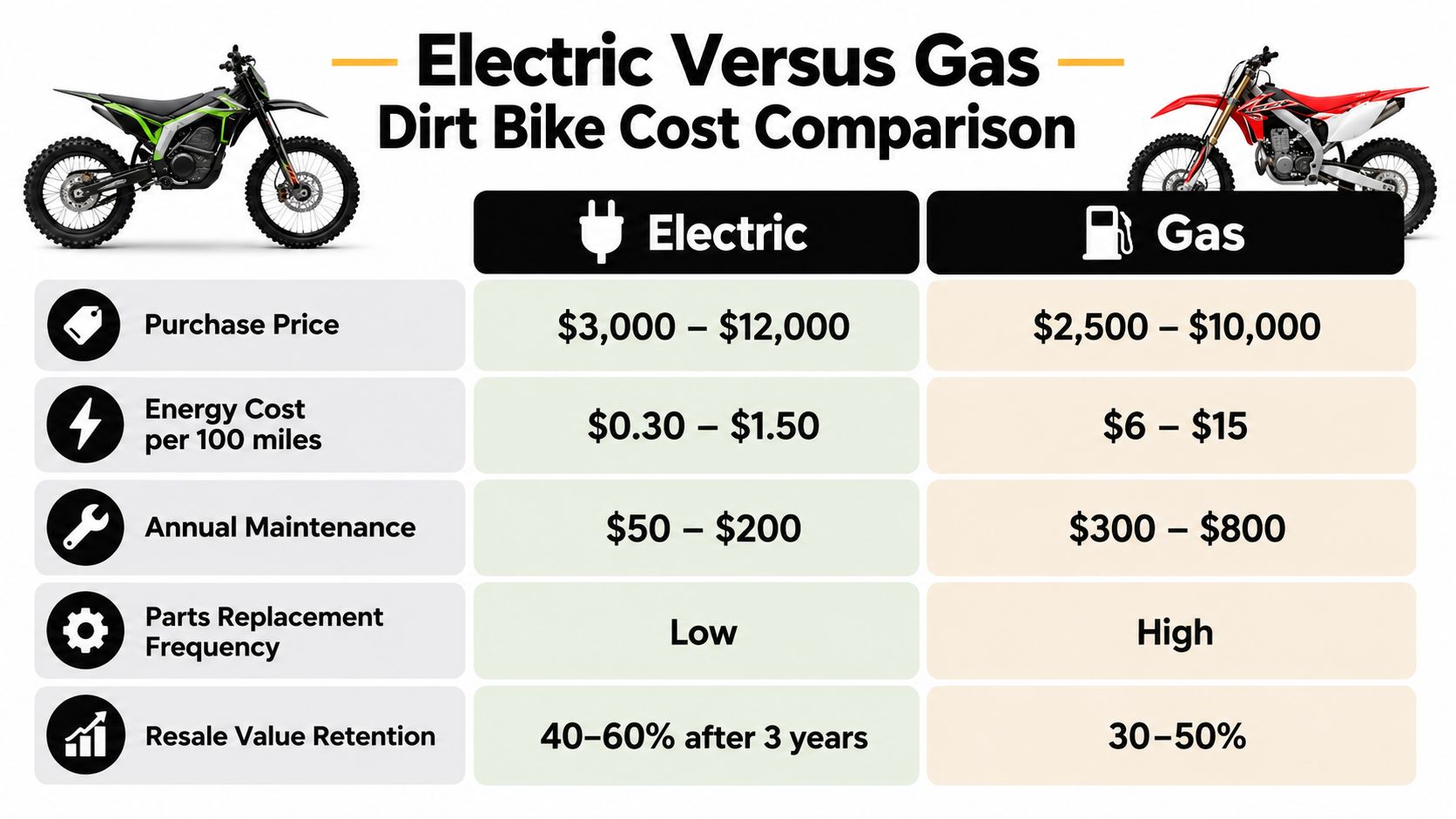
Electric and gas dirt bikes solve the same basic problem, but their costs appear in different places. Gas models often make refueling familiar and can offer a lower entry price in some categories. Electric models shift more of the expense toward the battery, charger, and initial purchase, then reduce the routine energy and mechanical workload.
Purchase and energy
A gas bike can be attractive when the buyer prioritizes familiar fueling, broad mechanical support, or a lower-cost used market. Electric bikes can be more convenient where quiet operation and home charging matter, particularly when the riding area is close to a power source.
The energy comparison favors electric operation in many situations because a charge uses a small amount of household electricity. Gas riders, however, may value the ability to carry fuel and resume riding quickly without waiting for charging.
Maintenance and mechanical complexity
Electric powertrains generally use fewer moving engine parts. Riders don't need the same routine engine service associated with combustion equipment, such as oil changes, air-fuel system work, or exhaust maintenance. Electric bikes still need attention to chains, sprockets, tires, brakes, suspension seals, fasteners, bearings, and battery connections.
Gas bikes remain familiar to many mechanics, and their engines can be repaired component by component. Electric troubleshooting may require diagnostic tools, controller knowledge, and access to model-specific parts.
Resale and duty cycle
Resale value depends on brand reputation, condition, service records, local demand, battery health, and whether the bike is legal for the intended use. An electric bike with a documented battery history can make a stronger impression than a similar bike with an unknown pack, while a popular gas model may have a larger established buyer pool.
The right choice depends on how you ride:
- Occasional recreational rider: Choose based on purchase price, transport, and access to charging.
- Frequent trail rider: Give battery durability, suspension, and replacement support more weight.
- Farm, ranch, or hunting user: Consider quiet operation, loaded range, charging access, and downtime if the pack needs service.
- Mechanical hobbyist: A gas bike may offer more familiar repair work, while an electric bike may reduce routine powertrain maintenance.
Neither technology wins every comparison. The better value is the one that matches your duty cycle instead of the one with the lowest advertised price.
Financing Incentives and Smart Buying Tips for Every Rider
A careful purchase starts before you compare monthly payments. Match the bike to its job first: occasional recreation, repeated trail use, property work, or a demanding commercial routine. Frequent riding increases the value of dependable battery support, available parts, and a service process you can use.
Use financing carefully
Compare the total repayment amount, not only the monthly figure. Ask whether dealer financing includes fees, whether the rate can change, and whether a personal loan has different terms. A smaller payment can still create a larger final bill when the repayment period is longer or the lender adds charges.
Local electric-vehicle incentives may exist, but eligibility depends on location, vehicle classification, registration status, and program rules. Check official local sources before counting a rebate in your budget. Treat an incentive as a possible reduction in cost, not money you already have.
Ask battery questions before paying
The battery deserves the same attention as the motor because charging is usually a small running expense, while replacing the pack can dominate long-term ownership. A dealer should explain the battery warranty, exclusions, service process, and replacement procedure.
Ask whether the pack is removable, whether replacement cells or a complete pack are available, and whether the warranty follows the bike if you buy used. Request the battery's age and charging history when possible. Clean plastics do not prove a healthy pack. Poor storage or repeated deep discharge can leave a used bike with a large future expense.
Inspect the bike as a system
Use a short inspection checklist:
- Battery: Look for swelling, damage, loose connectors, corrosion, or unclear labeling.
- Charger: Confirm that it matches the bike and completes a normal charging cycle.
- Controller and display: Test every mode, warning indicator, and control switch.
- Suspension: Check for leaks, play, damaged seals, and uneven action.
- Drive system: Inspect the chain, sprockets, belt if fitted, wheel bearings, and brake operation.
- Support network: Verify that the seller can supply wear parts and diagnose electrical faults.
A test ride remains valuable. Specifications cannot reveal throttle response, ergonomics, braking feel, or how the bike manages heat on a climb. For utility-oriented electric powersports, this electric side-by-side ATV overview helps distinguish a narrow trail bike from a machine built to carry people, tools, or equipment.
Making the Right Choice for Your Budget and Riding Goals
The best electric dirt bike isn't automatically the least expensive model or the one with the largest motor. It's the bike that fits the rider, the terrain, the charging routine, and the expected service life without forcing you to pay for capability you won't use.
Start with rider fit. A child needs controllable size and predictable power. An adult trail rider should prioritize adult ergonomics, chassis strength, suspension, brakes, and battery support. A landowner may accept less peak performance in exchange for quiet operation, dependable range, easy charging, and simple maintenance access.
Then set the budget in two parts:
- Acquisition budget: Include the bike, charger, protective equipment, delivery, and any setup work.
- Ownership reserve: Allow for tires, drivetrain wear, suspension service, storage needs, and eventual battery replacement.
The battery deserves its own line in your comparison. Charging is inexpensive, but a replacement pack can dominate long-term ownership for someone who rides often. Compare warranty terms and usable capacity rather than treating the advertised range as a complete value measure.
A used bike can be sensible when the seller provides clear battery information and the model has reliable parts support. A new bike may be safer for a first-time buyer who needs warranty coverage, dealer guidance, and a known starting condition. If you're also evaluating other powersports brands, this guide on whether CFMOTO vehicles are good offers a separate framework for weighing value, support, and intended use.
Before purchasing, arrange a test ride when possible, calculate a realistic charge and replacement budget, and ask the seller to explain what happens when the battery or controller needs service. That small amount of preparation can prevent a low sticker price from becoming an expensive ownership lesson.
Campus EV offers electric powersports built around practical value, reliable operation, and useful capability for work and recreation. Visit Campus EV to explore electric utility vehicles and compare your riding or property needs with a more complete ownership plan.