
Can a Beast golf cart handle your property work, or does it only look more capable than an ordinary cart? The answer depends less on its stance and accessories than on what you carry, where you drive, and how much battery reserve you need to get home.
A hunting trip along a maintained track is a different job from pulling a loaded trailer through mud. Understanding that difference helps you choose a suitable Beast configuration, avoid counterproductive modifications, and recognize when an electric utility side-by-side deserves a closer look.
Table of Contents
- Beast Golf Cart Specs at a Glance
- Stock Beast Models Versus Modified Builds
- Upgrades That Change Performance and Range
- Trail, Hunting, Ranch and Campus Use Cases
- Legal Rules, Safety and Winter Battery Care
- Buying Costs and Electric Versus Gas Trade-offs
- Choosing Between a Beast and an Electric UTV
Beast Golf Cart Specs at a Glance
What is a Beast, and how do the models differ? The lineup combines utility-cart features with equipment intended for hunting and property access. Start with the configuration name, not the camouflage or the accessories a seller has added.
The GolfCarts.com Beast product overview identifies the Beast 48 as a 2WD utility model, the Beast LE as adding an XO cage and double gun racks, and the Beast LE 4×4 as using dual electric motors, four-wheel drive, and four-wheel disc brakes. Listed utility equipment includes a heavy-duty front basket, receiver hitches, and a folding rear seat that converts to cargo space.
Beast Model Specifications
The table separates configuration-specific information from a separate electric utility listing. Unknown means the available listing doesn't establish that specification for that particular model, not that the vehicle lacks the component.
| Model | Drivetrain | Motor | Battery | Ground Clearance | Towing and Payload |
|---|---|---|---|---|---|
| Beast 48 | 2WD utility | Unknown | Unknown | Unknown | Unknown |
| Beast LE | 2WD utility configuration with XO cage and double gun racks | Unknown | Unknown | Unknown | Unknown |
| Beast LE 4×4 | Four-wheel drive, dual electric motors | Detailed specification discussed under upgrades | Lithium configuration discussed under upgrades | Verify against configuration sheet | Configuration-specific operating limits discussed under upgrades |
| Electric utility cart listing | Drivetrain unknown; independent front suspension listed | 5 kW AC | Lithium-equipped; capacity unknown | 8 inches at differential | Ratings unknown; listed vehicle weight is 995 pounds |
The same utility listing gives dimensions of 116 inches long, 53 inches wide, and 80 inches high. Those are published reseller specifications, not independent laboratory measurements.
Measure the Route, Not Just the Parking Space
Width matters at gateposts, between trees, and beside drainage ditches. Measure the narrowest usable opening with a tape measure, then consider turning clearance and any protruding racks or mirrors.
Don't assume every vehicle wearing the Beast name shares the utility listing's dimensions or hardware. Match the serial number, battery label, and equipment to the actual sales sheet before relying on a specification.
Stock Beast Models Versus Modified Builds
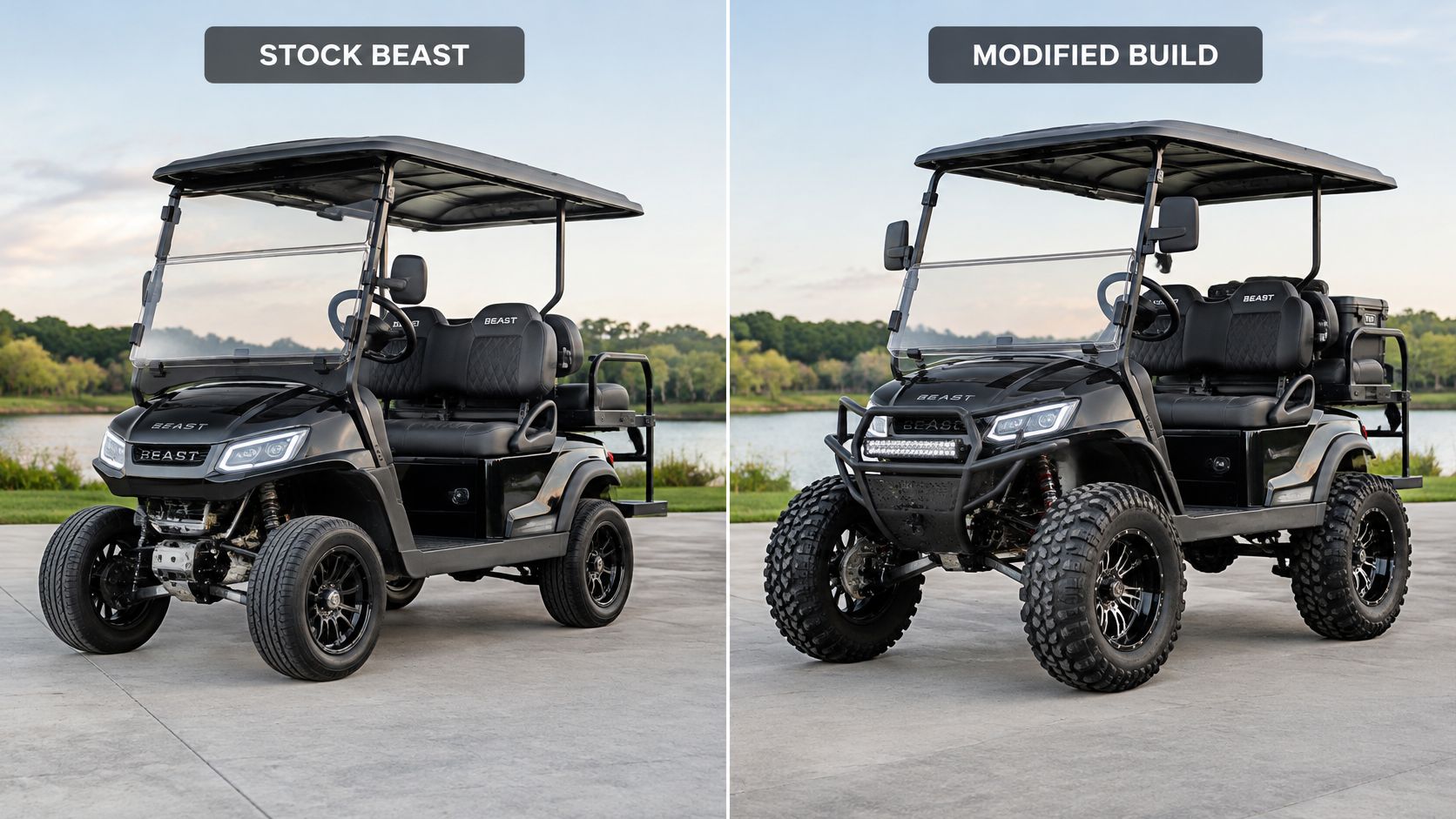
A stock Beast matches its delivered specification; a modified build has changes to components such as its suspension, tires, controller, motor, battery, or bodywork. That distinction matters more than whether the finished vehicle looks professionally assembled.
Think of a pickup as delivered versus the same truck after a suspension lift and larger tires. The altered truck may clear a particular obstacle more easily, but its original handling assumptions no longer tell the whole story.
This comparison illustrates the visible difference between standard equipment and an off-road-oriented build.
Inspect What Changed
- Identify the vehicle: Photograph the serial plate and request the original equipment sheet.
- Check the hardware: Compare tire sidewalls, controller labels, battery mounting, and charger identification with the documentation.
- Trace the installation: Ask for invoices, wiring diagrams, and the installer's name. Loose wiring and improvised battery restraints deserve attention.
- Confirm coverage: Get written answers about warranty exclusions, dealer servicing, and how your insurer treats the alterations.
Cosmetic changes belong in a different category from drivetrain changes. Seat covers can add a stylish touch for your golf cart from 2ndShotMVP without being evidence of greater towing or trail capability.
Judge Modifications by the Problem They Solve
Say a hunter installs taller tires to cross a rutted logging road. The cart clears the rut, but acceleration feels weaker and the brakes require more effort on the return descent. The original obstacle wasn't the only thing the owner needed to evaluate.
A modified vehicle's resale value also depends on whether a buyer trusts the work and can obtain replacement parts. An expensive customization isn't automatically worth its installation cost to the next owner.
Buying rule: Choose stock equipment when you need a documented baseline. Modify only after identifying a specific limitation and checking the consequences with a qualified installer.
Upgrades That Change Performance and Range
An upgrade should solve a measured problem, not increase a number on a sales sheet. Consider the whole system before changing any component.
| Upgrade | What It Changes | Trade-off |
|---|---|---|
| Lift kit | Chassis height and room for larger tires | Higher center of gravity and altered steering geometry; braking behavior needs reassessment |
| Larger tires | Obstacle clearance and traction characteristics | Potentially greater rolling resistance, shorter range, and changed effective gearing |
| Higher-output motor | Available torque and hill-climbing capability | Requires compatible controller, wiring, and battery current capability |
| Lithium battery | Pack weight, available energy, and maintenance requirements | Charger compatibility, installation quality, and warranty terms need checking |
| Dual-motor 4×4 drivetrain | Driven-axle traction and control | More components, installation complexity, and potentially greater energy consumption |
Installed upgrade prices are unknown until quoted. Request separate written prices for parts, labor, programming, and any supporting electrical changes rather than assuming the advertised component price covers the job.
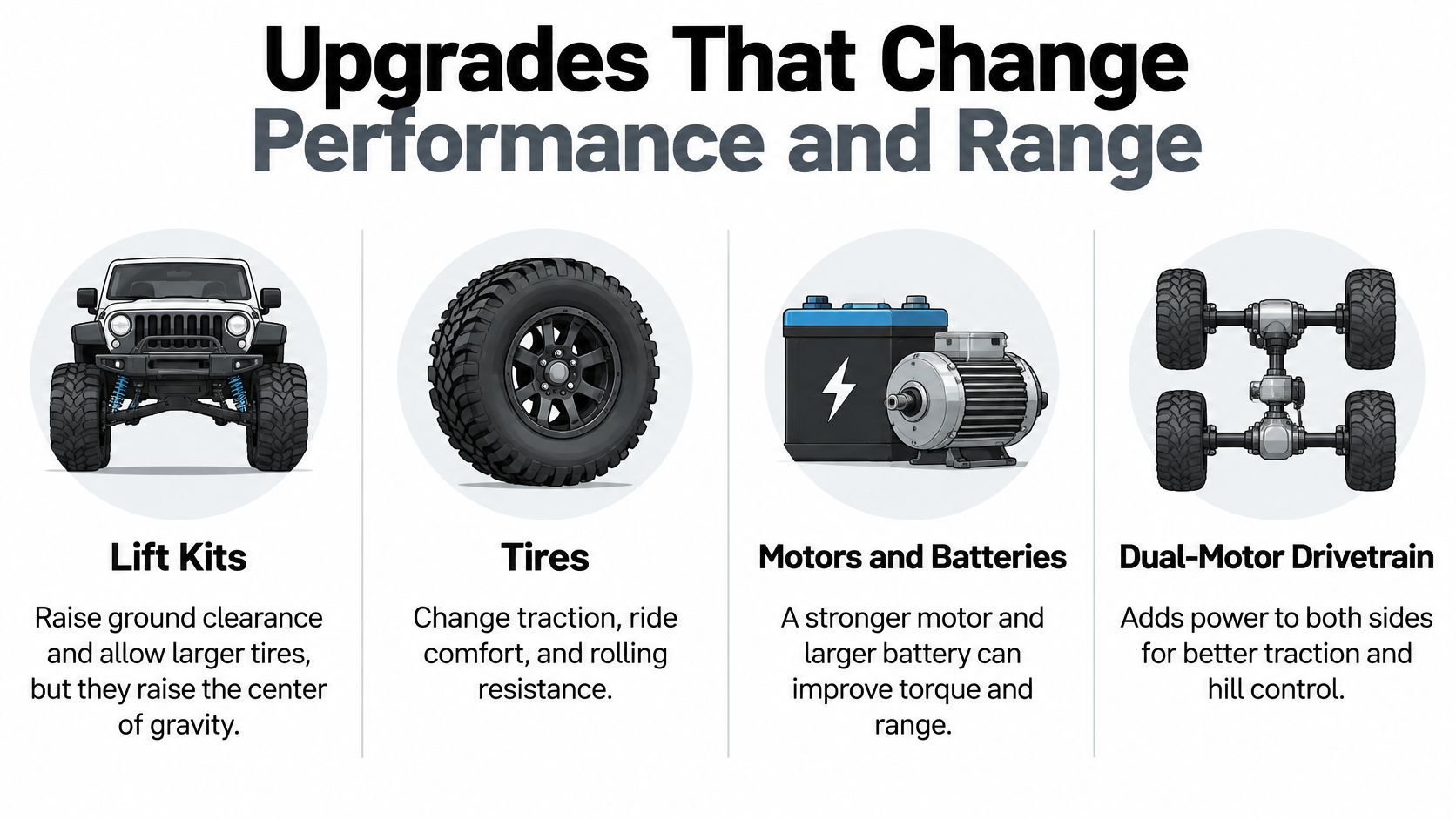
The main upgrade families are summarized below.
What the LE 4×4 Example Actually Establishes
The Beast LE 4×4 specification sheet lists a 5 kW rear motor, 3.5 kW front motor, and 72 V, 105 Ah lithium battery, equivalent to approximately 7.56 kWh of nominal stored energy. It also lists 8 inches of differential clearance, 23×10×12 tires, 500 pounds of towing capacity on flat ground, and a 600-pound payload.
Nominal energy isn't a guaranteed driving distance. Battery-management reserves limit accessible energy, while temperature affects availability and payload, tire pressure, and terrain affect consumption.
The configuration also lists independent suspension and disc brakes at every wheel. Those features matter for maintaining wheel contact and controlling speed, but they don't cancel the vehicle's operating limits.
Match the Upgrade to the Limiting Component
A suspension lift doesn't necessarily raise the differential. Taller tires may improve that clearance, but aggressive tread doesn't automatically improve traction on every surface. Use a side-by-side tire size comparison to understand dimensional changes before ordering.
Likewise, a stronger motor doesn't automatically increase consumption during identical light-duty driving. It permits higher demand, which the battery and controller must support. A lithium conversion isn't automatically a range upgrade either; usable energy matters more than the chemistry label alone.
Keep heavy cargo low and positioned according to the vehicle's loading instructions. Change one item at a time, then repeat a familiar route with comparable load, tire pressure, and starting charge so you can identify what improved.
Trail, Hunting, Ranch and Campus Use Cases
A trail with firm dirt and shallow ruts asks something different of a vehicle than a muddy hillside. Before choosing a Beast golf cart for off-road access, walk the difficult sections and identify whether the main obstacle is clearance, grip, turning space, or safe descent.
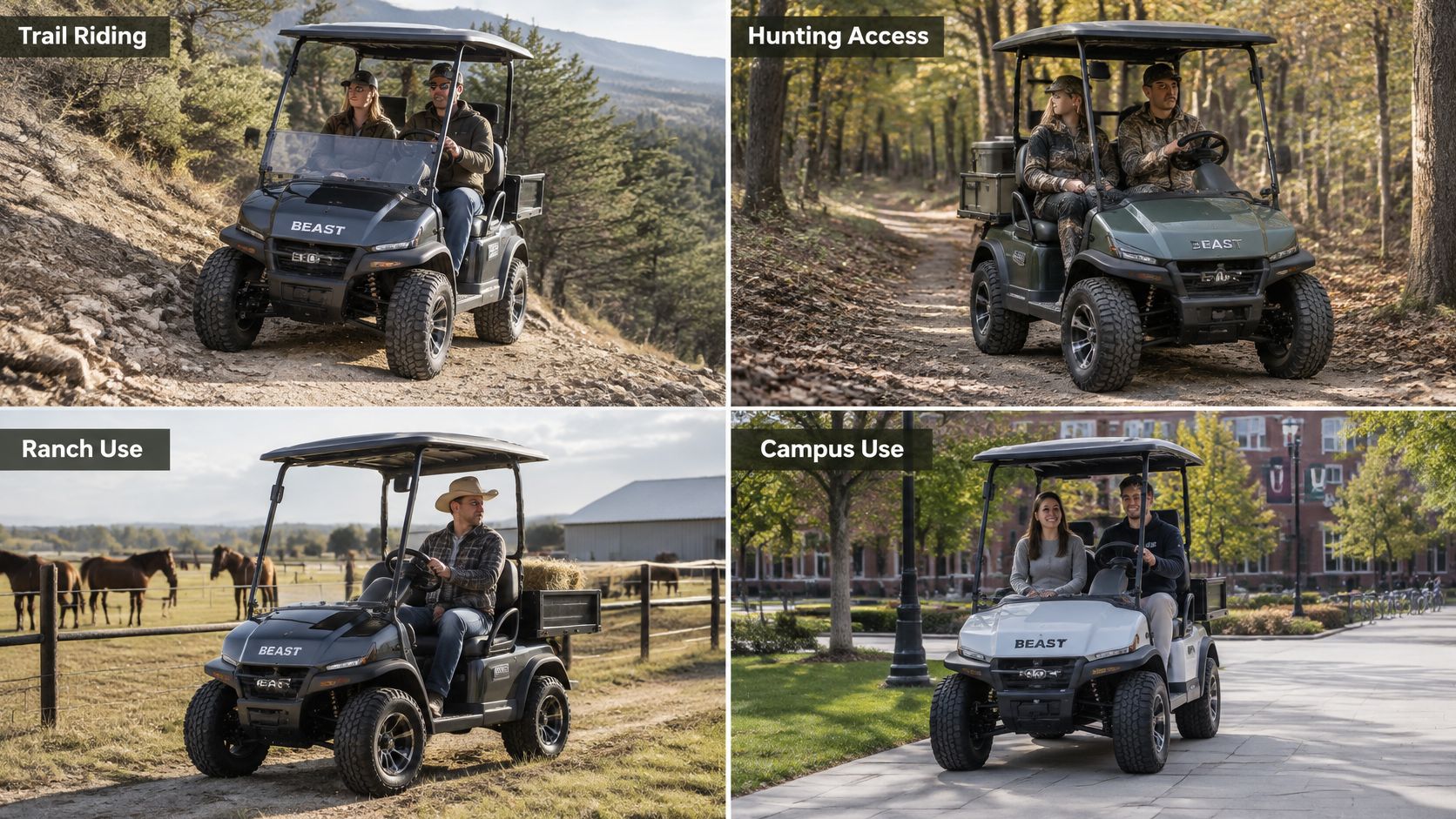
The same vehicle can suit one property task and be inappropriate for another.
| Use Case | Typical Load and Surface | Key Requirement | Beast Fit |
|---|---|---|---|
| Trail and off-road | Occupants and equipment on dirt, ruts, and slopes | Clearance, driven-wheel traction, safe braking | Conditional fit for moderate trails with the LE 4×4 |
| Hunting access | Gear, narrow access routes, early departures | Gate clearance, secure storage, dependable return range | Good when the route and equipment fit |
| Ranch work | Feed, tanks, trailers, mud, and recovery tasks | Documented load ratings and suitable recovery equipment | Limited for heavy towing or sustained demanding work |
| Campus or property mobility | Light loads on maintained paved paths | Turning room, permitted speed, parking access | Strong fit when site rules allow |
Hunting Access and Ranch Work Aren't the Same Job
For hunting, secure equipment so it can't shift into the driver's space or interfere with steering. Plan the return journey with the expected load, not just the easy outbound trip. A comparison of hunting utility vehicles can help distinguish access-focused transportation from equipment built around hauling.
Ranch work exposes a different constraint. Say an owner connects a trailer carrying a full tank, then discovers the combined trailer and cargo exceed the cart's documented towing allowance. A stronger motor wouldn't make that combination acceptable.
Wet soil also changes the job itself. If the task is clearing land rather than transporting people and tools, DirtPusher's traction options for land-clearing equipment illustrate a different equipment category, not an accessory recommendation for a Beast.
Use driving footage to examine vehicle layout and operation, but don't treat a demonstration as proof of suitability for your load.
Paved Mobility Has Different Priorities
On a campus or maintained property, getting through service gates and turning beside parked equipment may matter more than aggressive tires. Check pedestrian separation, loading locations, and where the vehicle can remain parked without blocking access.
Write down loaded weight, surface conditions, and daily distance before choosing. Those details usually tell you more than the vehicle's appearance.
Legal Rules, Safety and Winter Battery Care
Don't assume an off-road-equipped cart is road legal. Before using public roads, confirm the vehicle's classification and permitted routes with the relevant state and local authorities. Ask specifically about required equipment, registration, insurance, driver eligibility, and crossings.
A cage, lights, or receiver hitch doesn't establish legal status or increase an operating rating. For property use, secure cargo, inspect the brakes, and avoid routes where a safe stop or turnaround isn't possible.
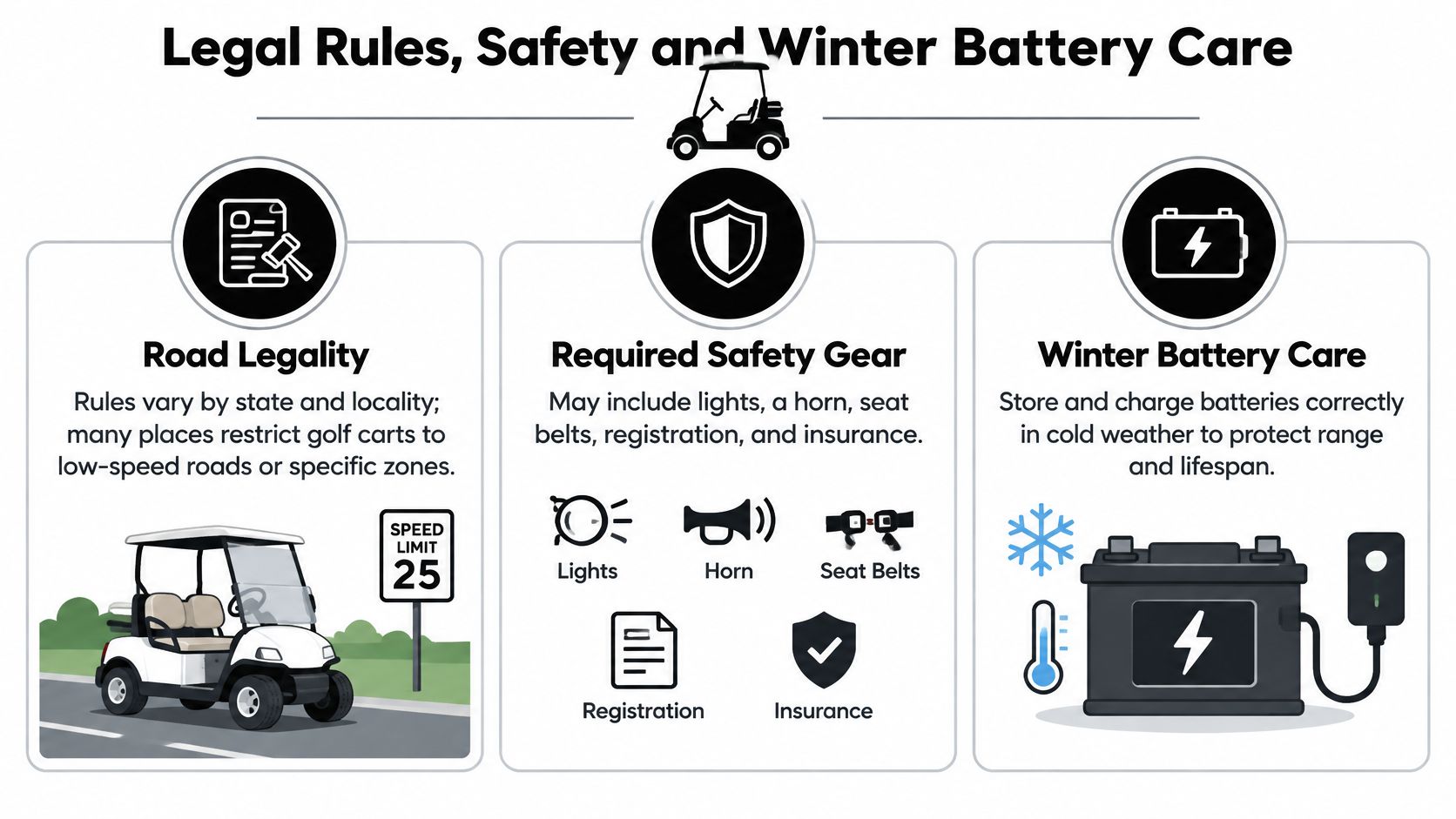
Use this checklist as a reminder of the separate legal, vehicle, and battery questions.
Prepare the Battery for Seasonal Storage
The Interstate Batteries lithium golf-cart safety manual emphasizes battery-appropriate charging and inspection guidance, including a recommended 15–35°C operating range and weekly visual checks for swelling or leaks. That general operating guidance isn't a substitute for the installed battery's separate charging and storage temperature limits.
A partly charged storage state is generally preferable to leaving a pack full or discharged, but obtain the specific target from the battery manufacturer. Don't apply another pack's storage instructions to an unidentified conversion.
- Check temperature before charging: Follow the battery's permitted charging range. Don't assume a cold-weather discharge allowance also permits charging.
- Provide dry shelter: Protect the charger and connections from precipitation, standing water, and condensation exposure.
- Inspect connectors safely: With the system isolated according to its instructions, look for corrosion, loose plugs, damaged insulation, and heat discoloration.
- Record the charge state: Check periodically during storage. Accessories may continue drawing power even when the cart isn't being driven.
- Follow the shutdown procedure: Use the manufacturer's long-storage isolation instructions rather than disconnecting components at random.
When a Stored Pack Won't Wake
If a discharged pack won't accept a charge, stop repeated attempts and contact the battery supplier or a qualified service technician. Don't bypass the battery-management system or improvise a jump-start procedure.
Lithium reduces routine battery maintenance. It doesn't remove the need for temperature checks, secure connections, and a planned storage routine.
An outdoor winter setup can only be judged after checking the pack, charger, shelter, and electrical supply together. There isn't a safe universal yes-or-no answer.
Buying Costs and Electric Versus Gas Trade-offs
The Beast electric utility cart has a starting price of $11,599, published by GolfCarts.com in 2026. Treat that as a starting point, not a delivered, ready-to-work total.
Request an itemized quote covering the exact battery, charger, accessories, delivery, taxes, and preparation charges. The published starting price alone doesn't establish which of those items are included, so don't assume the charger is either included or excluded.
Electric Versus Gas Cost Factors
| Cost Item | Electric | Gas | What to Compare |
|---|---|---|---|
| Purchase price | Published starting price; obtain configured quote | Current comparable price unknown | Equivalent equipment and delivered totals |
| Energy cost | Electricity through the supplied compatible charger | Fuel consumption and local pump prices | Annual use and actual energy consumption |
| Routine maintenance | Brakes, tires, bearings, and electrical inspections | Engine servicing plus chassis maintenance | Service schedules and local labor charges |
| Battery replacement | Traction pack is a potentially substantial future expense | No traction pack; starter battery may still require replacement | Coverage, replacement availability, and installed price |
| Cold-weather performance | Battery temperature can restrict available energy and charging | Starting reliability and fuel condition need attention | Off-season storage and readiness requirements |
Electric vehicles avoid engine oil and spark-plug servicing, but they aren't maintenance-free. Gas vehicles can resume operation after refueling without waiting for charging, although they bring engine service and fuel-storage responsibilities.
Don't assume every electric configuration can use any ordinary outlet. Verify the charger's input requirements and have the intended circuit checked if its condition or capacity is uncertain.
Questions That Make Quotes Comparable
- Battery coverage: What failures are covered, what exclusions apply, and is replacement coverage prorated?
- Charging equipment: Which charger is supplied, and does it match the installed pack?
- Written ratings: What are the vehicle's payload and towing restrictions in the purchased configuration?
- Local support: Who performs diagnostics, supplies parts, and handles warranty transport?
- Final payment: What delivery charges, financing terms, and optional items change the total?
For organized property transport, golf cart logistics with Freeform House provides a useful planning reference when considering rental coordination rather than ownership alone. For a broader purchasing comparison, review side-by-side prices by equipment and intended workload, not just the advertised entry price.
Compare the cost of completing your work, not merely the cost of buying a vehicle.
Estimate yearly operating hours and distance, then apply local electricity or fuel costs and written service quotes. Keep battery replacement as a separate budget item so a low charging bill doesn't conceal a larger long-term expense.
Choosing Between a Beast and an Electric UTV
A Beast is a reasonable candidate for light-duty property travel; a work-focused electric UTV deserves closer evaluation for demanding hauling and rough-ground tasks. Neither category label proves suitability. Choose the particular vehicle whose documented limits and equipment match the job.
Market popularity doesn't settle that decision. A golf-cart market forecast published by the National Law Review discusses projected industry expansion, but a market forecast isn't evidence that a cart can handle your trailer, terrain, or work schedule.
Score Your Actual Workload
Use low, medium, or high ratings to describe your work. These aren't engineering thresholds; they're a way to identify where you need stronger evidence.
| Input | Low Demand | Medium Demand | High Demand |
|---|---|---|---|
| Annual operating hours | Occasional trips | Regular property use | Sustained daily work |
| Daily distance | Short trips with charging nearby | Repeated routes with planned charging | Long routes with little charging flexibility |
| Surface | Maintained pavement | Firm tracks and moderate unevenness | Mud, steep ground, or deep ruts |
| Heaviest load and recovery needs | People and light tools | Frequent cargo or occasional trailer use | Heavy trailers, bulky loads, or routine recovery work |
A farm operator hauling feed through wet tracks may score high for surface and loaded work even with a short route. A campus facilities worker carrying hand tools on pavement may score low for both, making maneuverability and support more important than maximum drivetrain output.
For a concrete alternative, our Campus E1 is a 4×4 electric UTV with a 20 kW motor, a 72V 150Ah lithium battery, on-demand 2WD/4WD, and an electric power dump bed. Its stated range is up to 60 miles per charge, which should still be evaluated against your work conditions rather than treated as a guaranteed loaded route.
Make the Final Decision in Order
- Record your workload before shopping. Include occupants, tools, trailer weight, expected surfaces, and recovery requirements.
- Obtain the operating limits in writing. Confirm whether towing approval applies to your terrain and distinguish cargo-bed capacity from total vehicle payload.
- Compare ownership totals. Include charging equipment, delivery, replacement parts, warranty terms, and access to qualified service.
- Arrange a representative test drive. With dealer approval, use a secured, permitted load and comparable terrain. Record distance, charge consumption, and recharge time.
A successful demonstration doesn't authorize exceeding a published limit. If the vehicle struggles within its ratings or leaves inadequate reserve, choose a different configuration rather than expecting an upgrade to fix every mismatch.
Campus EV offers electric utility side-by-sides for hunting access, property transport, and farm or ranch work. Visit Campus EV to find an authorized dealer and book a test drive, bringing your load list and route requirements so you can compare a utility UTV with a Beast on the work you need to do.