
You've spent the morning hauling feed through mud, and now the loaded bed won't tilt. The key is on, the display looks normal, but pressing the dump switch gets you nothing. Before you order a motor or bridge a relay, find out whether the bed has lost electrical power, jammed mechanically, or stopped moving hydraulic oil.
An electric bed not working on a UTV can also signal something more serious than a failed switch. A crooked latch or damaged hinge can put bed hardware against the battery enclosure. Start with clearance and safe support, then follow the fault instead of repeatedly pressing the switch.
Table of Contents
- What a Silent Dump Bed Usually Means
- Check Key Power Fuses and the Dump Switch
- Measure Relay and Actuator Voltage Under Load
- Free a Jam Check Hydraulics and Battery Clearance
- Habits That Stop the Next Dead Bed
- Hand the Bed to a Dealer
What a Silent Dump Bed Usually Means
Silence and a straining motor call for different checks. No click and no movement point toward key power, a fuse, the relay control circuit, the dump switch, or the supply feeding them. A motor that hums without lifting points toward inadequate power under load, mechanical resistance, or a hydraulic problem.
Identify what lifts your bed. An electric linear actuator has a motor and extending rod connected between the chassis and bed. An electric-over-hydraulic system uses an electric pump, reservoir, hoses, and hydraulic cylinder. Don't apply an actuator diagnosis to a pump that runs but isn't moving oil.
Dump bed symptoms and the first safe check
| Symptom | Likely system | First check | Stop if |
|---|---|---|---|
| No click, no motion, display may be blank | Key switch, fuse, relay, or low battery | Key on, state of charge, bed fuse or breaker | Smell, heat, or exposed battery parts |
| Relay click only | Power contacts, wiring, or open actuator | Voltage at actuator while commanding up | Rated voltage and zero motor current |
| Motor hums, bed stuck | Overload, debris, seized pivot, or hydraulic bind | Unload cargo and inspect hinges | Bed or latch touching the battery cover |
| Raises but will not lower, or the reverse | Limit switch or incorrect switch wiring | End-of-travel switches and switch connector | Anyone is tempted to defeat an interlock |
| Slow or partial lift | Voltage sag, weak pump, or low fluid | Actuator or pump voltage under load | Voltage collapses well below rating |
| Bed creeps down or will not hold | Actuator brake or hydraulic valve | Support the bed; don't stand under it | Load is unsupported or hardware is bent |
A quiet switch with no relay click means you haven't established that a movement command reaches the power circuit. Replacing the lifting assembly at that point is guesswork. A motor that strains and stalls deserves a different response: release the switch and remove the resistance before trying again.
Stop before another switch cycle
A burning smell, melted connector, cracked battery cover, or latch touching the pack means stop using the vehicle. Don't test whether another press will free it.
Before inspection, use the manufacturer's bed support or a prop rated for the load. A properly rated restraint may prevent movement where the service procedure allows it, but a cargo strap isn't a substitute for a rigid support beneath a raised bed. Keep everyone out from underneath.
Utility-vehicle faults can affect neighboring safety systems: the CPSC's Intimidator and Mahindra recall documented 40 incidents, including 12 involving brake-line impact after universal-joint failure. That wasn't a dump-bed recall, but it's a practical reason to inspect surrounding hardware rather than bypass a fault.
Check Key Power Fuses and the Dump Switch
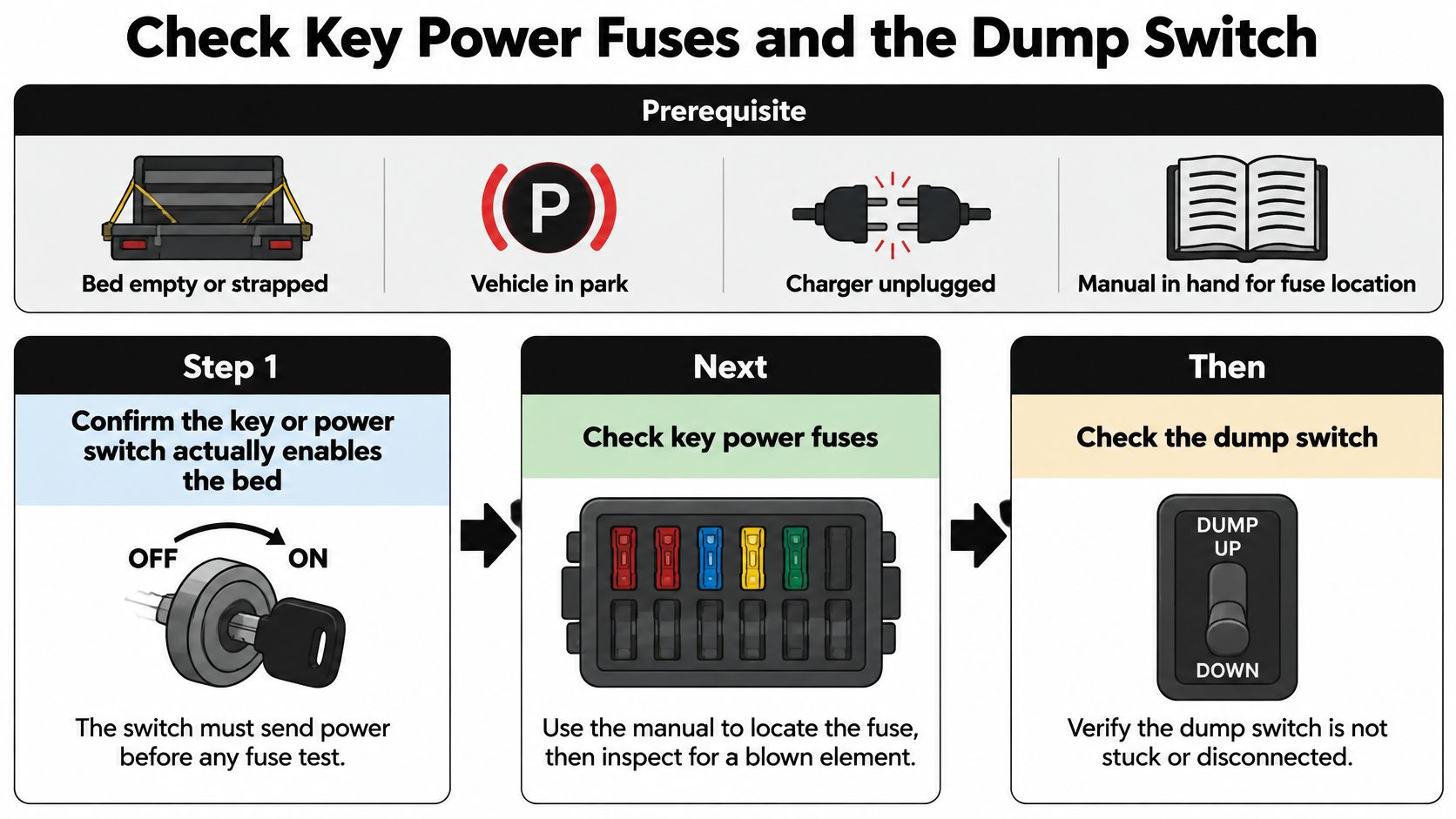
Empty the bed if you can do so safely, park on firm ground, set the parking brake, and unplug the charger. Keep the manual open to the fuse layout and bed wiring diagram. Before touching the switch, inspect the hinge, latch, and added toolboxes for contact with the battery cover.
Establish power before blaming the switch
Confirm the key enables the bed circuit. Follow the manual's operating conditions, including any park or accessory-power requirement. A live display establishes that some power is available, not that the bed circuit is healthy. A blank display widens the investigation to the main supply, accessory supply, connections, and contactor controls.
Read the state of charge and any fault message. If the whole vehicle is weak or unresponsive, don't keep demanding lift from the bed. A discharged vehicle needs its battery condition assessed before you can fairly judge the dump motor.
Find the correct fuse or breaker. Look in the locations identified by the manual, which may include a chassis fuse block or a protected high-current connection near the supply. With power isolated as instructed, remove the fuse and check continuity with a multimeter. Replace it only with the same specified type and amperage. A larger fuse can let the wiring overheat instead of clearing the fault.
Command both directions briefly. Listen at the relay, not just at the rocker switch. A click followed by immediate release or chatter suggests an unstable command or supply; no click keeps attention on the fuse, switch, interlocks, and relay coil circuit. Don't assume a particular number of clicks proves a component good.
Inspect the wet and moving connections
Check the switch connector. Isolate power before unplugging it. Look for green corrosion, pushed-back terminals, a broken locking tab, and mud preventing the rocker from returning. Use connector-safe electrical cleaner where permitted, dry the connection, and reconnect it securely. A connector that won't latch needs repair, not tape holding it halfway together.
Inspect the hinge harness. With movement disabled, look for stretched wires, crushed insulation, and a loom rubbing a sharp bracket. Don't reach into the hinge while a helper operates the switch. Any movement-dependent electrical test must keep hands outside the entire travel path.
Practical rule: A good fuse and an audible relay click earn a voltage test. They don't earn a jumper wire.
If the display stays dead, don't automatically connect the charger. Check for swelling, cracked housings, unusual heat or odor, damaged cables, loose connectors, and contamination around the charging equipment. Nationwide's electric-vehicle charging guidance emphasizes damaged equipment and charging-location hazards.
Only charge an apparently undamaged vehicle using the specified equipment and a sound electrical connection, away from hay, fuel, and other combustibles. Don't open the battery enclosure, bridge the dump switch, or hold a relay closed to get the last load off.
Measure Relay and Actuator Voltage Under Load
A relay click proves movement inside the relay, not usable power at the motor. Burned power contacts can click normally while failing to carry the load. Likewise, a corroded cable can show voltage with the switch released and lose it when the motor demands current.
Use a digital multimeter rated for the circuit and the manufacturer's wiring diagram. If accessing the terminals requires opening the traction battery enclosure, probing unidentified high-voltage wiring, or removing protective barriers, stop and use a qualified technician.
Test at the device, not just the battery
Prepare the bed under the manufacturer's service procedure. It must be supported for inspection, but never command motion against a fitted prop or tight restraint. For a powered test, arrange safe permitted travel, keep everyone clear, and position the meter leads before enabling movement.
- Identify the actual supply. Read the actuator or pump-motor rating and trace its circuit. The traction-pack voltage isn't automatically the voltage used by the bed.
- Back-probe the correct terminals. Measure across the actuator motor terminals during the command, rather than assuming chassis metal is the correct return. A reversing actuator may change meter polarity when direction changes.
- Record commanded voltage. Compare the reading while the motor should be moving with its rated supply. Use only a brief command if the motor stalls.
- Check current safely if equipped. Use an appropriate DC clamp meter around the relevant conductor. Don't put a handheld meter's current terminals across the supply.
- Separate control from load delivery. With proper isolation, check relay contacts and wiring continuity as the diagram directs. Never perform resistance testing on an energized circuit.
Firgelli's linear-actuator troubleshooting guidance provides an approximate benchmark of within 10% of rated voltage while moving under load. Treat the vehicle manufacturer's specifications as controlling, especially for systems with electronic motor control.
Read the result before buying parts
| Reading or behavior | What it suggests | Next action |
|---|---|---|
| Voltage stays near the device rating and movement is normal | Supply reaches the motor under load | Investigate intermittent wiring or load conditions |
| Voltage drops sharply during the command | Weak supply, cable resistance, poor connection, or protection opening | Test supply and voltage drop across connections |
| Rated voltage, no motor current | Open winding, thermal protector, limit switch, or internal control fault | Check device-specific service procedure |
| High current, no movement | Stalled motor, overload, or mechanical binding | Release switch immediately and inspect resistance |
| Command reaches relay coil but not its output | Failed contacts or missing load-side supply | Verify relay feed and contacts |
| Operation fails in one direction | Directional control, limit circuit, or associated wiring fault | Trace that direction on the diagram |
A hydraulic system may power the pump only for lifting and use a valve for lowering. Don't condemn it because the pump stays silent on a lowering command.
Keep added accessory circuits identifiable. When planning equipment through our UTV winch and accessories guide, don't treat a convenient bed-circuit wire as an accessory power source.
Without a meter and a matching diagram, this is a sensible stopping point. Diagnostic bypasses belong to technicians using current-limited equipment, not a field jumper.
Free a Jam Check Hydraulics and Battery Clearance
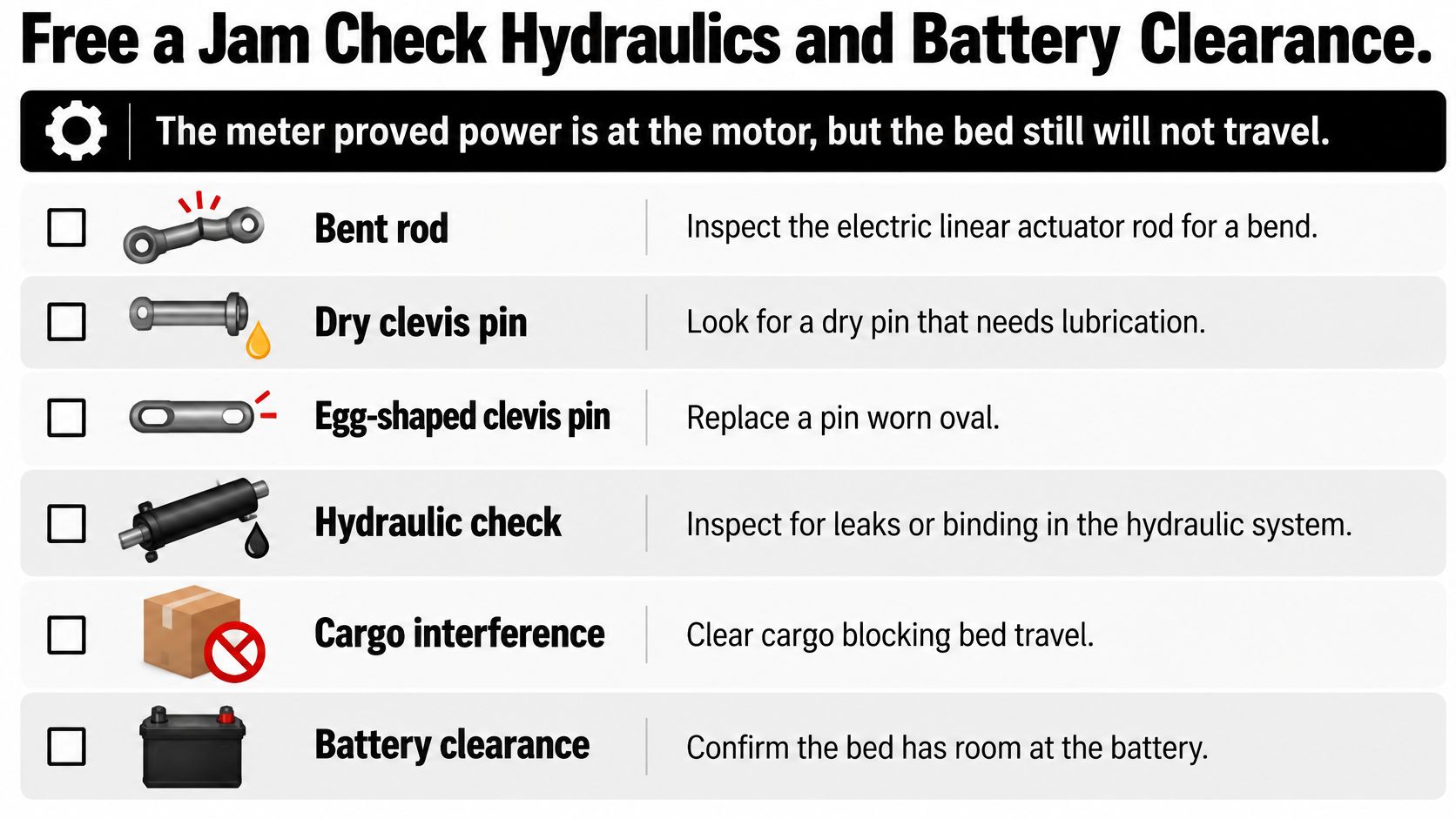
Power reaches the motor, but the bed still won't travel. Identify what's resisting movement before applying more power. An extending actuator and a hydraulic pump can produce similar sounds while failing for very different reasons.
When a linear actuator binds
Say wet feed has shifted forward against the cab and a stake side has twisted in its pocket. The actuator is now pushing against trapped cargo rather than tipping the bed. Unload from a safe position before retrying; don't use the motor to tear the obstruction loose.
With power isolated and the bed supported, inspect:
- Actuator alignment. A bent rod, twisted mount, or rod entering the housing sideways needs repair.
- Clevis pins and holes. Dry pins can bind; worn pins or oval mounting holes let the actuator cock under load. Lubricate only the service points the maker specifies.
- Hinges and cargo clearance. Remove lodged stones, branches, packed mud, and material trapped between bed and cab.
- End-of-travel operation. A failed or stuck limit switch can prevent movement in a direction. Don't bridge it to force extra stroke.
Don't remove a loaded actuator pin to “see whether it's stuck.” That pin may be holding the bed up.
When the hydraulic pump runs without lifting
A running pump with no lift can indicate low fluid, air entering the suction side, a relief-valve problem, or a manual lowering valve left open. Look for external leaks and check that the lowering control is in its normal operating position.
Check reservoir level on level ground, with the bed positioned as the manual requires, commonly fully lowered. Use the specified hydraulic fluid and marked fill level. If the bed cannot be lowered safely, don't guess how much fluid to add.
A hot pump and slow lift can mean oil is passing through relief rather than extending the cylinder. Wrong fluid or a restriction can also interfere with operation. Never loosen a pressurized hose to test for flow, and never search for a hydraulic leak with your hand.
Check the battery-clearance geometry
Transport Canada's March 9, 2024 Textron recall covered Hauler Pro and Hauler Pro X Elite vehicles equipped with a triple-battery pack, where a dump-bed latch could damage the pack's top cover and create a fire risk even while parked and switched off. The remedy called for battery inspection, damaged-module replacement when necessary, and a clearance bracket.
That recall applies to a defined configuration, not every electric UTV. Check the exact vehicle and recall status rather than assuming either coverage or safety.
A bed that still lifts can still be unsafe if its latch or frame is striking the battery enclosure.
Look for scraped coating on the pack, pinched cables near the hinge, shifted mounts, or a bed sitting crooked after impact. Don't cycle it to watch the contact happen. Leave the enclosure closed and stop using the vehicle.
Habits That Stop the Next Dead Bed
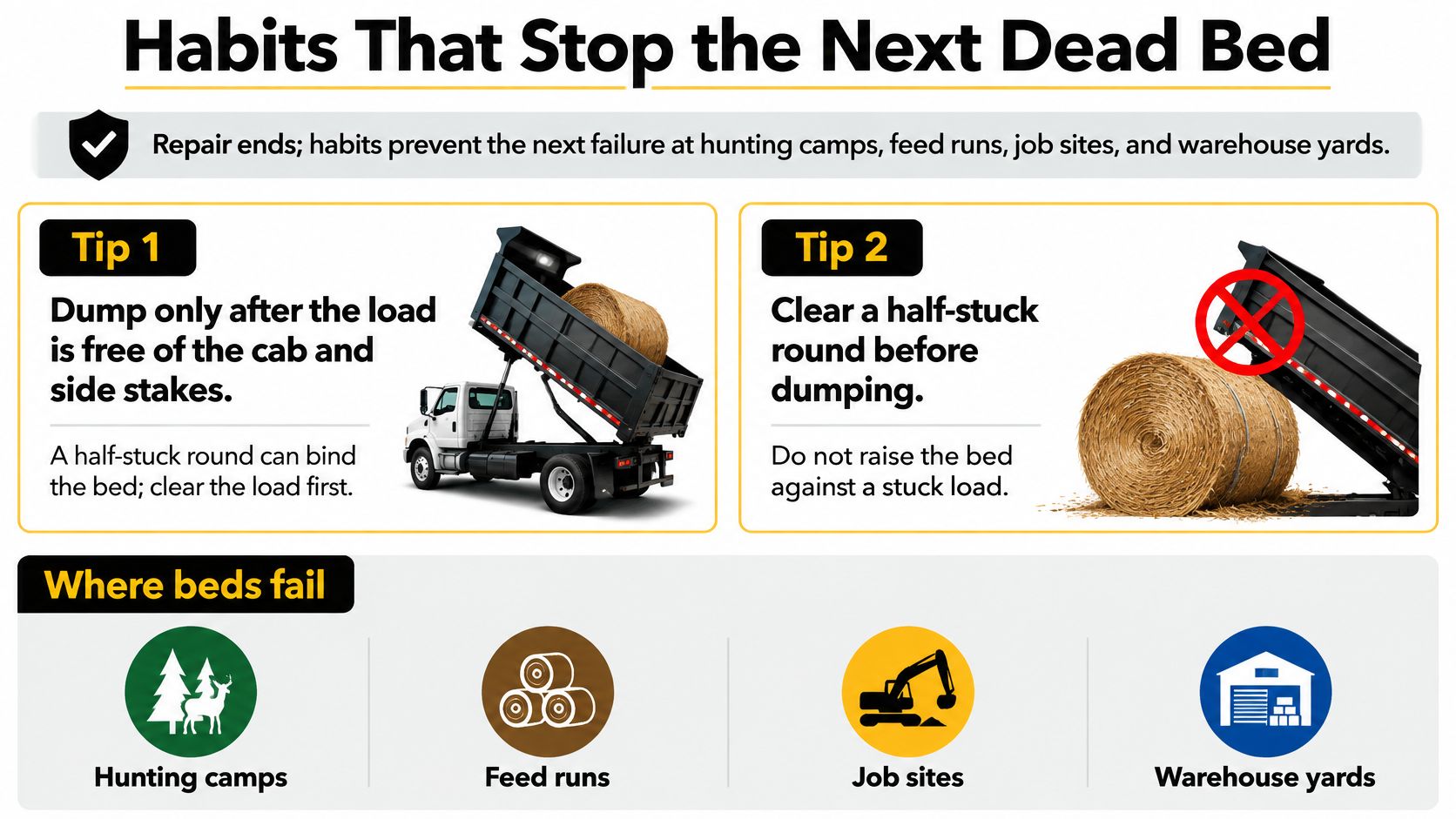
The cheapest bed repair is often the load you straighten before pressing the switch. Hunting camps, feed runs, construction sites, and warehouse yards create different kinds of abuse, but the useful habit is the same: give the bed a clear path and notice changes before forcing another cycle.
Make the first empty lift count
After a muddy hunting trip, check the space around the hinges before loading again. A branch wedged behind the bed can twist a mount when the actuator extends. During the first empty lift, listen for a new grind and watch from outside the travel path for sideways rod movement.
On feed runs, clear a half-stuck bale or snagged sack before dumping. Cargo caught against the cab or stake sides can turn an otherwise reasonable load into a mechanical stop. Match cargo to the bed's stated hauling and dumping limits, not to what fits between the sides.
At a warehouse or job site, distribute material instead of piling it against a corner. Secure tools so they can't fall into the lifting mechanism. Review our electric UTV performance guidance when load planning and whole-vehicle performance need attention together.
A working dump switch isn't permission to ignore a crooked bed over the battery.
Clean connections without creating another fault
After creek crossings or washdowns, inspect accessible connectors and their seals. Unplug them only where the manufacturer permits, with power isolated, and let contaminated connections dry before reassembly. Use dielectric grease only as specified for the connector seals; it won't repair corroded metal or a loose terminal.
Keep the pressure-washer nozzle away from the hinge loom, switch, and electrical seals. Remove packed mud gently, then inspect the harness clips. A missing clip can leave a sound wire rubbing through on the next rough trip.
- Before parking overnight. Lower the bed fully when safe and clear loose material from the hinge area.
- Before seasonal storage. Don't leave the bed partly raised with its harness stretched and load resting on the lift mechanism.
- Before charging. Give the cord, plug, charger, and vehicle a visual check rather than reconnecting by habit.
Store the battery deliberately
For a hunting-season machine, record a recurring state-of-charge check through the off-season. For an intermittently used farm UTV, make that check part of the shed inspection. For a daily warehouse vehicle, assign charging and fault reporting to a specific operator.
Compact Equipment's electric-UTV ownership guidance warns that allowing a battery to reach and remain at 0% can leave it non-recoverable. Store the vehicle dry and ventilated, and follow its prescribed storage charge level and charger procedure instead of assuming continuous connection is always correct.
After cold storage, follow the battery's temperature and charging instructions before judging bed performance. Don't attempt improvised battery recovery if the pack won't accept a normal charge.
A fuse that opens again, proper motor voltage without useful movement, or any battery contact means the next job is diagnosis and repair, not another operating workaround.
Hand the Bed to a Dealer
Call the dealer the same day if the bed or latch has marked the battery cover, wiring is burned, the pack is swollen or unusually hot, or you notice an unexplained chemical odor. Stop using and charging the vehicle. If it's smoking, hissing, or rapidly heating, move people away and contact emergency services rather than trying to transport it.
A fuse that opens again after a correct replacement also needs professional diagnosis. So does an actuator receiving its rated supply but failing to move after a simple external obstruction is cleared. Don't guess when the wiring diagram doesn't match the vehicle's battery configuration or modified harness.
Know what an owner can reasonably finish
A cleaned and dried switch connector, a correctly replaced fuse that remains sound, or an accessible hinge service completed under the manual's procedure can be an owner-level finish. Hydraulic fluid replenishment is only a finish when the correct level and fluid restore operation and any reason for fluid loss has been addressed.
Bring useful evidence to the appointment:
- Vehicle identification. Year, model, serial number, and battery configuration.
- Observed behavior. Silence, relay click, motor strain, directional failure, or drifting.
- Test results. Voltage measured during the command, not just resting battery voltage.
- Safe photographs. Hinge, latch, visible wiring, and accessible battery-cover damage without removing protective covers.
For our Campus E1, the electrically tilting dump bed includes stake pockets and four tie-downs, and its hauling limit is 550 lbs. Those features help secure a load; they don't justify forcing a jammed bed. Use our electric UTV dealer locator to arrange a service conversation with the vehicle details ready.
Campus EV offers electric UTVs for hunting, farm, ranch, and property work, including the Campus E1 with an electric dump bed. Visit Campus EV to explore the vehicle and connect with a dealer about bed operation, load requirements, and your next practical step.