
You're standing in a barn with two listings open on your phone. One's a gas utility machine with a winch and a plow already bolted on. The other's an electric side-by-side the seller says "hasn't been used much." Both look clean in the photos, both are priced within a few hundred dollars of each other, and neither listing tells you the one thing you need to know: will it haul a loaded bed of feed up your hill in November and still get you and a deer back to the trailer after dark?
That's the question behind the best used UTV for farm and hunting, and it isn't answered by an hour meter. A used work machine earns its price through repeated utility trips, and on an electric unit the value sits mostly in a battery you can't see and a range figure that was measured under conditions nothing like yours. Buy on the wrong number and you'll own a very quiet lawn ornament.
Table of Contents
- Which Used UTV Spec Decides Your Farm or Hunting Work
- Electric vs Gas UTVs for Farm and Hunting Use
- Matching Range and Charging to Your Route
- Inspecting a Used Electric UTV Before You Pay
- Ownership Costs, Warranty and Battery Replacement
- Shortlist Your Used UTV and Test It Under Load
Which Used UTV Spec Decides Your Farm or Hunting Work
Start with the jobs, then find the spec that decides each one. This table pairs common farm and hunting work with the specification that governs it, using the Campus E1 as a concrete reference point.
Priority spec by farm and hunting use case
| Use case | Priority spec | Reference value (Campus E1) |
|---|---|---|
| Daily farm chores | Dump bed and payload | 550 lb dump bed haul |
| Towing feeders, trailers and gear | Tow rating and hitch receivers | 2,500 lb tow; front and rear 2-inch receivers |
| Hunting access and recovery | Winch and 2WD/4WD control | 3,000 lb winch; switchable 2WD/4WD |
| Wet clay and steep grades | Ground clearance and traction | 11 in ground clearance; locking rear differential |
| Remote or long routes | Usable range | Up to 60 miles on a single charge |
The reason to shop this way is structural. The USDA's 2022 Census of Agriculture tracks tractors, trucks and pickups, machinery and equipment values, and machinery-related expenses as separate line items, which tells you equipment is a standing operating cost on a farm, not an occasional purchase. A machine that saves twenty minutes a day, every day, beats a faster one that sits waiting on a repair.
Rank the specs by how often they fail in use
Traction fails first. On-demand 2WD/4WD paired with a locking rear differential is what gets you out of wet clay and up a rutted grade, because an open differential sends power to the wheel with the least grip and spins it. If a used unit only offers part-time four-wheel drive with no lock, treat it as a dry-weather machine.
Payload comes second, and it's the spec buyers most often exceed without noticing. Two people, a cooler, a chainsaw, a spare tire and a bed full of soaked firewood add up fast. A bed loaded past its rating sagging on worn springs will scrub tires unevenly and change how the machine brakes on a descent. Judge towing the way you'd judge a pickup: hitch rating and tongue weight, not the sticker on the fender.
Then clearance and suspension travel, which decide whether you drive over a washout or through it. Range reserve sits fifth for most owners and first for a few, depending entirely on where you charge. Noise is a tiebreaker, not a reason to buy.
Utility first, traction second, comfort last. A heated cab on a machine that can't pull your trailer is money spent in the wrong order.
Private ground and public ground pull in different directions
The U.S. Fish and Wildlife Service's 2016 national survey found that of 11.5 million hunters aged 16 and older, 9.7 million (85%) hunted on privately owned land. That's why hauling, winching and repeated short trips usually matter more than top speed for most buyers reading this.
Public-land hunters face a different constraint. Motorized travel is often limited to designated roads or trails, so check the specific unit's motor-vehicle use map before you pay for off-road capability you can't legally use. Quiet running and easy gear hauling still help on long approaches to a stand.
If you're pricing accessories alongside the machine, Audio Jam's overview of trail-ready upgrades for Delaware drivers is a sensible filter for which add-ons solve a work problem and which just add weight.
Write down your three most frequent jobs. Score every listing against that ranked list, not against the seller's description.
Electric vs Gas UTVs for Farm and Hunting Use
Here's the honest side-by-side, with the Campus E1 sitting in the electric column as the working example.
Electric vs gas UTV for farm and hunting work
| Factor | Electric UTV | Gas UTV |
|---|---|---|
| Low-speed torque | Immediate torque from the electric motor | Builds with engine revs |
| Noise | Near-silent running for dawn hunts | Engine noise carries |
| Cold weather | Battery capacity drops in cold | Starts reliably with fuel |
| Refueling or charging | Hours plugged in, usually overnight | Refuel in minutes |
| Remote work with no power | Needs a charger or enough range | Works anywhere fuel is available |
| Towing and winching | Strong low-speed pull; winch drains battery | Depends on engine and drivetrain |
| Range | Up to 60 miles per charge (Campus E1) | Depends on tank size and load |
The Campus E1 runs a 20 kW permanent-magnet synchronous motor on a 72V 150Ah lithium battery, with on-demand 2WD/4WD and an electric dump bed. Multiply 72 volts by 150 amp-hours and you get roughly 10.8 kWh of stored energy before real-world losses, which sets your working distance.
This chart lays out the same trade-offs in a form you can scan before a test drive.
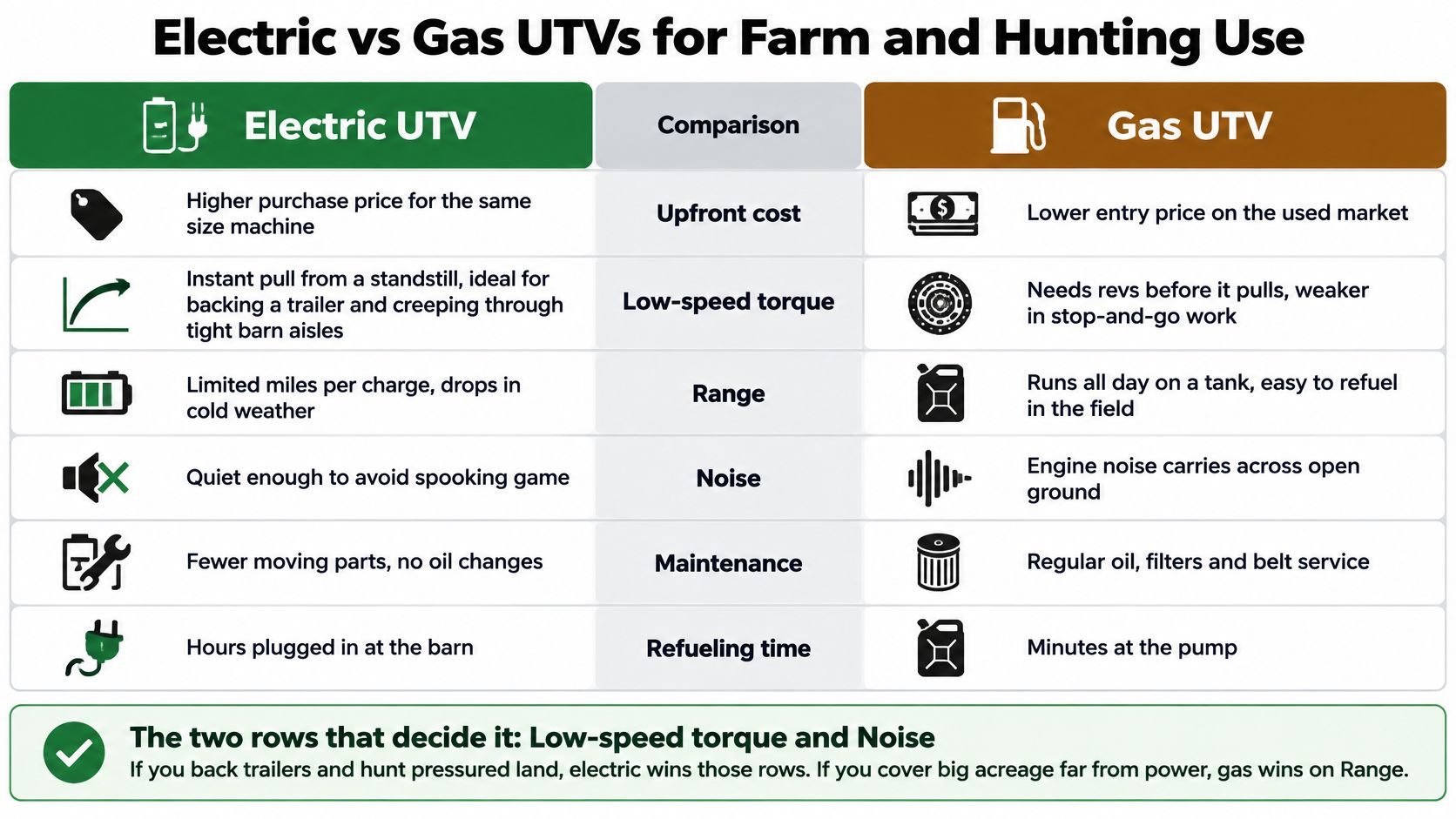
The two rows that decide it for you
Low-speed torque and noise are where electric wins work. An electric motor makes full pull from a standstill, so backing a trailer into a tight barn aisle or creeping through a gate becomes a one-foot job instead of a clutch-feathering exercise. There's no belt to slip and no revs to build. On pressured ground at first light, a machine that doesn't announce itself across an open field is worth real money to a hunter.
Range and refueling are where gas wins, and they win decisively in one scenario: work far from an outlet. A jerry can in the truck bed resets a gas machine in minutes. A depleted pack at a remote camp does not reset at all.
The Campus E1 tows up to 2,500 lbs, hauls 550 lbs in its electric-powered dump bed, and clears 11 inches of ground clearance, so the utility side of the comparison isn't the weak point. Charging access is. A farm with a barn outlet on the daily route fits electric cleanly. A hunter who camps a week off-grid needs gas, or a mixed plan where the electric machine handles property work and something else handles the far lease.
Watch how the two powertrains behave in the field before you commit to either.
Cold is the row buyers forget. Lithium packs deliver less usable capacity when they're cold-soaked, and a machine parked in an unheated shed all night starts the morning behind. Plan your winter routes around that, not around the summer number.
Matching Range and Charging to Your Route
Headline range is a marketing figure measured on flat ground with a light driver. Your route is fence lines, a creek crossing, a hill, and a loaded return. Size the energy from the duty cycle instead.
- Measure the outbound route as you drive it. Include the detour to the far water tank and the loop along the back fence, not the straight-line distance on a map.
- Add the return with the load you expect. Game, feed, firewood or a sprayer changes the draw, and the loaded leg is the one that strands people.
- Correct for elevation, cold and stop-start work. Climbing and repeated low-speed maneuvering drain a pack faster than steady cruising, and winching pulls hard current in short bursts.
- Hold a reserve for recovery. Budget enough to winch yourself or a buddy out, plus a detour if the trail is washed out.
- Compare that total against the corrected range, not the sticker.
Campus EV rates the E1 at up to 60 miles on a single charge, which is a vendor claim you should verify under your own load. The wider category picture is more sobering: Campus EV's electric UTV buying overview cites nominal ranges around 25 to 45 miles and charging times of roughly 4 to 12 hours, with heavy loads and towing cutting a larger electric UTV to approximately 25 to 35 miles in real use.
Run your route twice, once against the claimed figure and once against the loaded figure. If the loaded number doesn't clear your round trip plus reserve, the machine doesn't fit, no matter what the brochure says.
Charging access is the spec that isn't on the spec sheet
Overnight farm charging and remote hunting are different problems wearing the same word. At the barn, a machine that plugs in every night resets to full before the morning chores, and a modest pack is fine. At a lease with no power, state of charge only goes one direction, and a flat pack can leave both the UTV and the trailer sitting where you stopped.
If you're adding a dedicated circuit in a barn or shop, have an electrician confirm the outlet, breaker sizing and ventilation before you buy, and compare 2026 EV charging code changes from ATEK Distribution so the install matches current requirements rather than whatever was done in the shed twenty years ago.
Owner-reported patterns help here more than spec sheets do. Reading through electric utility vehicle reviews tells you what a given machine does on hills and in cold, which is exactly the information a range figure hides.
The contrarian conclusion: a shorter-range used electric UTV that recharges reliably at home is often the better buy than a longer-range machine you can't plug in. Range you can't replenish is just a bigger number to be stranded with.
Inspecting a Used Electric UTV Before You Pay
Walk the visit in this order, and don't skip step one to go drive something.
Start with paperwork. Ask for service records, the hour meter reading, any battery history, and a straight answer about mud and water exposure. A machine that lived in a flooded creek bottom carries risk that no test drive will reveal in ten minutes.
Walk it cold, before it's been plugged in or warmed up. Look at tire wear patterns, shock bodies for seepage, bushings, frame welds around the hitch receivers and rack mounts, and the bed hinges. Uneven tire wear tells you it carried loads it shouldn't have or ran out of alignment.
Charge it twice. Once through the vehicle's own port, once from a separate charger if the seller has one. Watch for a charge session that terminates early and put your hand near the port afterward. Heat is information.
Load test it. Engage 4WD, lock the rear differential, climb the steepest grade available, then run the winch against a light load. A drivetrain that hesitates or grinds under load won't improve on the way home.
Get the battery warranty transfer terms in writing before any deposit. Verbal assurances don't transfer.
The gap in most used-machine advice is exactly here. Generic checklists, including the Fatboy's Offroad used UTV inspection guide, concentrate on hours, mileage, frame damage, tires, suspension and mud exposure, and treat the powertrain as an engine, transmission and belt problem. They rarely tell you how to assess a battery, charger, battery-management system or remaining warranty, and they suggest reserving 10 to 15% of the purchase price for immediate repairs. That reserve is a floor. A single battery or power electronics fault can outweigh it entirely.
Used electric UTV inspection items and red flags
| Inspection item | What to check | Red flag |
|---|---|---|
| Battery state of health | Request the BMS state-of-health report and cycle count | No written data or unexplained capacity loss |
| Charging | Charge from the vehicle and from a separate charger | Charge stops early or the port runs hot |
| Fault codes | Read stored codes on the display | Repeating or battery-related codes |
| Connectors and wiring | Look for corrosion, browning or melted insulation | Heat marks or green corrosion |
| Drive system | Test 2WD to 4WD and the locking rear differential | Delayed engagement, grinding or no lock |
| Winch and dump bed | Run the winch under a light load and tilt the bed | Slow winch or uneven bed lift |
| Tires and suspension | Check wear pattern, shock leaks and bushings | Uneven wear or leaking shocks |
| Frame and welds | Check mounts and hitch receivers for cracks | Cracks around hitch receivers |
| Warranty transfer | Get battery warranty terms in writing | Verbal promise only |
A clean-looking unit with no battery data is a worse buy than a scratched one with a full service history. Paint doesn't strand you.
Buying used gas instead? Swap the battery and charger rows for a compression test, oil and coolant condition, CVT belt wear and glazing, and a look for fuel-system leaks at the tank, lines and injectors. Everything else in the sequence stays the same, and the load test matters just as much.
Ownership Costs, Warranty and Battery Replacement
Costs arrive in a predictable order. Walk them that way and the used-versus-new question usually answers itself.
Purchase and financing
Start with the out-the-door number, then add the cost of money if you're borrowing. Retail financing is available for qualified buyers through local Campus EV dealers, so compare the total of payments against the cash price rather than shopping by monthly payment. A used machine with a lower sticker can lose its advantage once you price a battery reserve and a set of tires into year one.
The battery line
Replacement pricing on electric UTVs is frequently unpublished or estimated rather than quoted, which is why you ask for a written quote and the warranty terms before you hand over money. Get the pack's chemistry, the warranty's remaining term, whether it transfers to a second owner, and the delivered replacement cost. Treat the repair reserve you set aside during inspection as the minimum, then add a specific battery contingency on top of it.
Budget rule: if the seller can't produce a written replacement quote and transferable warranty terms, price the machine as though the pack is out of warranty, because that's the risk you're accepting.
Service, tires and accessories
Electric units skip oil changes, air filters and belt service. They don't skip brakes, tire rotation and replacement, suspension bushings, ball joints, differential fluid or brake fluid. Write down the interval and the parts cost for each item on the machine you're buying, and check published UTV maintenance cost breakdowns so your annual figure reflects real service rather than a guess.
Accessories change both cost and resale. Campus offers parts and accessories including an upgraded LiFePO4 lithium battery, heavy-duty cargo solutions and lighting add-ons, and a documented chemistry upgrade with paperwork is worth more at resale than an undocumented one. Poorly installed aftermarket wiring is worth less than nothing.
Five-year worksheet
| Line item | What to enter |
|---|---|
| Purchase or total loan payments | Cash price, or down payment plus every scheduled payment |
| Battery reserve | Written replacement quote, discounted by remaining warranty |
| Scheduled service | Brakes, fluids, suspension and drivetrain checks over five years |
| Tires | Two sets if you run gravel and pavement regularly |
| Accessories | Winch, cargo, lighting, cab, plus install labor |
| Resale at year five | Subtract, based on comparable listings today |
| Total cost per hour | Net total divided by the hours you'll actually run it |
That last row is the one that settles arguments. A machine used every morning across five years costs very little per hour even at a higher purchase price. A bargain that sits under a tarp costs a fortune per hour.
Shortlist Your Used UTV and Test It Under Load
Turn all of this into three candidates and one afternoon.
Rank your three most frequent jobs against the priority-spec table, then shortlist three used units that meet your top-ranked spec and clear every red flag in the inspection checklist. Anything with an unexplained capacity loss, a cracked hitch mount or a verbal-only warranty comes off the list before you drive it, no matter how good the price looks.
Run the identical load test on each candidate. Engage 4WD with the rear differential locked and climb the steepest grade you can reach. Tow your heaviest trailer, not the seller's empty utility cart. Winch a light load and watch the speed and the voltage readout while it pulls. Then drive your actual loaded route and record where the state of charge lands.
Shortlist decision table
| Candidate | Priority spec met | Red flags found | Route range |
|---|---|---|---|
| Used unit A | Yes, if it clears your top-ranked job spec | None, or drop it from the list | Must cover the loaded round trip plus reserve |
| Used unit B | Yes, if winch and 4WD both work under load | Any battery or frame flag ends the deal | Same loaded route, measured on the test drive |
| Used unit C | Yes, if payload and tow rating match your trailer | Written battery data or no sale | Reserve left after the loaded return leg |
| New Campus E1 benchmark | Dump bed, 2,500 lb tow, 3,000 lb winch | None expected | Up to 60 miles claimed; verify |
Keep the new E1 in the comparison as a control, not a fallback. The E1 is sold through authorized dealers, so you can run the same grade, the same trailer and the same winch pull on a known-good machine and see what a healthy drivetrain feels like. That baseline is what makes a tired used unit obvious. Products, vehicles, parts and accessories on our site are subject to availability and may be modified or discontinued without notice, so confirm the exact configuration and current warranty terms with your dealer before you schedule.
If no used unit passes every test, that's your answer. A used machine that fails the load test is a project, and projects don't feed livestock on a Tuesday morning.
Book test drives on two used units and one new E1 in the same week, bring your heaviest trailer to all three, and buy the one that clears every test with charge left over.
We build the Campus E1 around exactly the work this guide tests: a 20 kW motor, 72V 150Ah lithium pack, on-demand 2WD/4WD with a locking rear differential, an electric dump bed, a 3,000 lb winch and 2,500 lbs of towing, sold through authorized dealers with financing for qualified buyers. Bring your loaded route, your trailer and your three most frequent jobs to a dealer and run the same grade, tow and winch test on it that you'd run on any used listing. Visit Campus EV to see the current E1 configuration and find the dealer nearest your property.